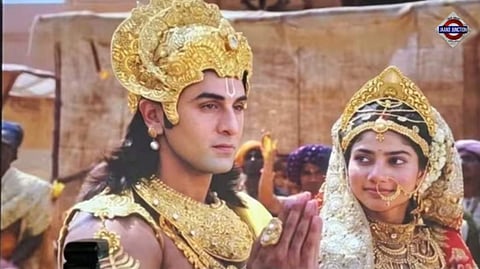

New images which claim to show on-set leaks from the upcoming epic Ramayana movie began to circulate online during the weekend but the discussion ended when a well-known television personality intervened.
The pictures, which circulated widely on X and other platforms, showed Ranbir Kapoor and Sai Pallavi costumed as Rama and Sita in ornate wedding finery. Their clarity and composition prompted immediate debate: were these genuine set stills or an expertly made fake? Many users pointed out technical oddities, unnaturally crisp detail, mismatched lighting and timing that didn’t align with the film’s shooting schedule and some asked whether AI tools had been used to swap faces onto older footage.
The rumour was decisively challenged when Ashish Sharma who famously played Lord Rama on television posted the image alongside the original still, calling out the edit as a face-swap from his earlier series. He directly identified the source frame and jokingly declared that "AI couldn't replace my hair," which showed how the viral image was constructed instead of being filmed at a modern movie studio. Independent outlets and fact-checks that traced the viral asset reached the same conclusion: the viral "leak" is an edit, not a verified production still.
That clarification matters because the stakes around Nitesh Tiwari’s two-part Ramayana remain very high: the film directed by Nitesh Tiwari and produced under the Prime Focus banner is being positioned as one of the most ambitious and expensive Indian productions in recent memory. The project has enlisted major VFX houses and global partners to build a cinematic world at scale, and the makers have been careful about how and when official material is released.
Officially, the ensemble cast includes names such as Yash, Ravie Dubey and Sunny Deol among others, and the production team has so far been selective with publicity which makes opportunistic “leaks” an easy vector for misinformation and speculation. Industry coverage and studio statements confirm the involvement of international VFX partners and staged promotional rollouts, so unauthorised images should be treated skeptically until verified.
What to take away: in the social-media era even high-profile projects are vulnerable to sophisticated fakery. Here, an actor who once embodied the role spotted the giveaway and the reporting that followed tied the viral asset back to an earlier TV still a tidy example of how verification from people close to source material and basic visual forensics can quickly separate fact from fiction. Fans still hungry for an official glimpse will have to wait for the makers’ carefully timed reveals.

