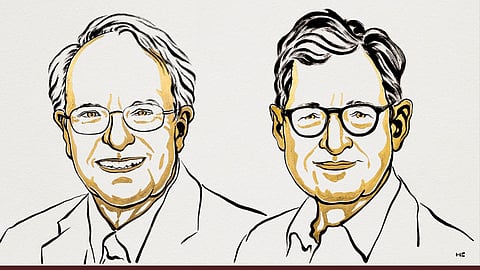

American economists Robert E. Hall and Michael Woodford have won the 2026 Nobel Memorial Prize in Economic Sciences for research that has helped reshape how economists understand and manage fluctuations in the economy.
The Royal Swedish Academy of Sciences announced the award on Monday, October 12, honouring the two researchers “for microeconomic foundations of macroeconomic stabilisation.” Their work has helped develop economic models that governments and central banks use to assess policy decisions and respond to recessions, inflation and other disruptions.
Hall is a professor at Stanford University in California, while Woodford is a professor at Columbia University in New York. The two economists will share the prize money of 12 million Swedish kronor, approximately US$1.2 million.
Their research addresses a fundamental question: how can governments and central banks reduce the damaging effects of economic booms and downturns without creating new problems?
Economies rarely move in a straight line. Periods of growth can be followed by slowdowns, businesses may cut investment during uncertain times, and households may reduce spending when jobs or incomes appear at risk.
During a recession, governments and central banks can take measures to support economic activity. Central banks may lower interest rates, making borrowing cheaper, while governments can increase spending or use other fiscal measures to support demand.
When inflation rises sharply or an economy begins to overheat, policymakers may take the opposite approach, tightening monetary policy or reducing fiscal stimulus.
The challenge is knowing which measures to take, when to take them and how households and businesses are likely to respond.
Hall and Woodford's research has helped strengthen the theoretical foundations of the economic models used to answer these questions. The Nobel committee said their work improved the ability of policymakers to implement effective stabilisation policies and reduce the severity of economic fluctuations.
For much of the 20th century, economists developed models that examined relationships between large economic indicators, including inflation, employment, production and consumption.
However, the economic crises of the 1970s — marked by high inflation, unemployment and weak growth — exposed important limitations in existing approaches.
Hall and Woodford contributed to a shift towards models built on the decisions of individual households and businesses. This approach, known as microfoundations, examines how people make decisions about spending, saving, employment and pricing, and how these decisions combine to shape the overall economy.
It also recognises that people and businesses are forward-looking. A household deciding whether to spend or save, for example, may consider future income and interest rates. A business setting prices may take account of expected costs and future demand.
When a central bank announces a policy change, those expectations can influence decisions even before the policy has its full effect.
By connecting individual behaviour with economy-wide outcomes, the researchers helped establish a stronger foundation for modern macroeconomic models. These models are now used to analyse monetary and fiscal policy across the world.
Robert E. Hall, born in 1943 in Palo Alto, California, is a prominent economist associated with Stanford University.
His research has covered consumption, labour markets, economic growth and macroeconomics. One of his influential contributions examined how households make consumption decisions over time, rather than simply responding to their current income.
This distinction matters because spending patterns influence economic demand. If households expect lower future income or face uncertainty, they may save more and spend less. When many households make similar decisions, the effect can spread across businesses, employment and overall economic activity.
Hall's work has helped economists examine these relationships and understand how individual choices can shape broader economic outcomes. His research has also contributed to the wider development of modern macroeconomic theory.
Michael Woodford, born in 1955 in Chicopee, Massachusetts, is a professor at Columbia University and one of the leading scholars in modern monetary economics.
His influential work examines how central banks' decisions and communication affect inflation, economic activity and public expectations.
A central idea in modern monetary policy is that interest-rate decisions work partly through what people expect to happen next. If a central bank communicates a credible plan for managing inflation, businesses and households may adjust their pricing, borrowing and spending decisions accordingly.
Woodford's research helped establish a rigorous theoretical framework for understanding these effects. His work has been particularly influential in the development of forward guidance — when central banks communicate their likely future policy intentions to influence economic expectations today.
The importance of Hall and Woodford's research becomes clearer when economies face sudden shocks.
An energy crisis can raise production and transport costs, pushing prices upwards while slowing economic activity. A sudden decline in consumer spending can hurt businesses, reduce investment and put jobs at risk.
Policymakers must respond while accounting for how their decisions affect households, businesses and expectations about the future.
The models developed from this body of research help economists assess how different policy choices might influence the economy. They do not eliminate uncertainty or guarantee that every intervention will succeed, but they provide a more systematic framework for evaluating the likely effects of policy.
According to the Nobel committee, this research has strengthened the theoretical foundations of the models used by governments and central banks around the world.
The economics award is formally called the Sveriges Riksbank Prize in Economic Sciences in Memory of Alfred Nobel.
Unlike the original prizes in Physics, Chemistry, Physiology or Medicine, Literature and Peace, it was established by Sweden's central bank in 1968 and first awarded in 1969. It is not one of the five prizes specified in Alfred Nobel's original will, although it is awarded alongside the Nobel Prizes and is commonly referred to as the Nobel Prize in Economics.
The 2026 award is the final announcement of this year's Nobel season, following the prizes in Medicine, Physics, Chemistry, Literature and Peace. The award ceremony is scheduled for December 10, the anniversary of Alfred Nobel's death.
Hall and Woodford's Nobel recognition highlights the importance of understanding not only what happens to an economy, but also why households, businesses and policymakers behave as they do.
Their research has helped connect individual decisions to larger economic outcomes, giving policymakers a stronger basis for responding to inflation, recessions and unexpected shocks.
For ordinary people, these questions are far from abstract. Interest rates influence home loans and business borrowing; inflation affects household budgets; and economic slowdowns can shape employment opportunities.
The research recognised by the 2026 Economics Prize helps explain the complex mechanisms behind these everyday realities — and why the timing and design of economic policy matter.

