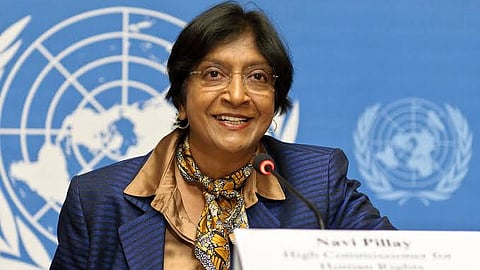

South African jurist Navanethem “Navi” Pillay has won the 2026 Nobel Peace Prize, recognising a lifetime of work defending human rights, advancing international justice and strengthening the role of law in resolving conflicts.
The Norwegian Nobel Committee announced the award on Friday, October 9, honouring Pillay for her efforts to promote peace and international law. The committee highlighted a career that began with defending opponents of apartheid in South Africa and later took her to some of the world's most significant international courts.
At 85, Pillay becomes the latest recipient of one of the world's most prominent international honours. The award carries a prize of 12 million Swedish kronor, approximately US$1.2 million, and is scheduled to be presented in Oslo on December 10.
Born on September 23, 1941, in Durban, South Africa, Pillay grew up during apartheid, the system of institutionalised racial segregation and discrimination that governed the country for decades.
Of Indian Tamil descent, she pursued law at a time when South Africa's racial hierarchy restricted opportunities for non-white citizens. She graduated from the University of Natal, now the University of KwaZulu-Natal, before building a legal career that would eventually take her to the highest levels of international justice.
In 1967, Pillay became the first woman to establish a law practice in Natal Province and went on to defend people opposing apartheid. Her legal work included exposing the treatment of detainees and advocating for the rights of people facing political persecution.
Following the end of apartheid, she became the first Black woman to serve as a judge on South Africa's High Court. It was the beginning of a career that would see her help shape international legal responses to genocide, crimes against humanity and sexual violence.
One of the defining chapters of Pillay's career began in 1995, when she was appointed a judge at the United Nations International Criminal Tribunal for Rwanda.
The tribunal was established to prosecute those responsible for genocide and other serious violations of international humanitarian law committed during the 1994 Rwandan genocide.
Pillay served at the tribunal for eight years, including four as its president from 1999 to 2003. During this period, she contributed to landmark proceedings that helped establish important precedents in international criminal law.
Among the most significant was the case against Jean-Paul Akayesu, a former Rwandan mayor convicted of genocide and crimes against humanity. The case established a landmark precedent by recognising that rape and sexual violence could constitute acts of genocide when committed with the requisite intent.
The ruling represented a major development in the prosecution of sexual violence during armed conflict. It helped establish that such crimes could be central to the destruction of a protected group, rather than treated as incidental consequences of war.
Pillay's work in Rwanda was followed by another major appointment. In 2003, she became a judge at the International Criminal Court in The Hague, which prosecutes individuals accused of genocide, crimes against humanity, war crimes and, under its jurisdiction, the crime of aggression.
In 2008, she was appointed United Nations High Commissioner for Human Rights, taking charge of the UN office responsible for promoting and protecting human rights around the world. She held the position until 2014.
Her responsibilities included addressing human rights violations, supporting international accountability mechanisms and advocating for protections for vulnerable communities. Her career has also involved work on equality, freedom from discrimination and the rights of detainees and survivors of abuse.
The Nobel Committee's decision places international law and accountability at the centre of this year's Peace Prize.
Announcing the award, the committee pointed to the connection between Pillay's early work defending people who stood against apartheid and her later service as a judge in major international cases.
The committee also stressed the importance of international legal institutions at a time when wars and conflicts are increasing and institutions of international law face political pressure. Its message was that lasting peace depends not only on diplomatic agreements, but also on the ability to resolve disputes without force and hold perpetrators of serious crimes accountable.
Pillay's career reflects that approach: defending individuals facing state repression, participating in trials addressing mass atrocities and helping advance legal standards for prosecuting crimes that have historically been difficult to address.
The Nobel recognition therefore highlights the role of legal institutions in pursuing justice for victims and preventing impunity.
Beyond her judicial appointments, Pillay has been involved in efforts to advance women's rights and combat discrimination. She co-founded Equality Now, an international organisation working to protect and promote the rights of women and girls.
Her career has repeatedly brought questions of equality, dignity and accountability into international legal forums. Her work has also contributed to the development of legal standards addressing sexual violence, hate propaganda and other human rights violations.
The UN human rights office welcomed her Nobel win on Friday. A spokesperson described the news as significant and said greater dedication and commitment to human rights were needed.
Pillay's award comes at a time when international conflicts, civilian suffering and disputes over the authority of international institutions remain major global concerns.
Her recognition draws attention to a central question: how can peace endure when serious violations of human rights go unpunished?
Her work offers one answer through the institutions and principles of international justice — documenting crimes, establishing legal responsibility, protecting victims and ensuring that the powerful are not beyond the reach of the law.
The 2026 Nobel Peace Prize recognises that decades-long effort. From apartheid-era South Africa to international courts, Navi Pillay's career has been shaped by the conviction that justice and human dignity must remain central to the pursuit of peace.

