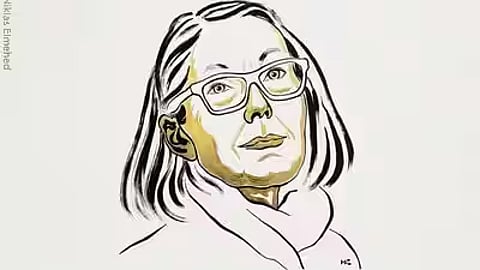

Canadian poet, essayist, translator and classicist Anne Carson has won the 2026 Nobel Prize in Literature, becoming the latest writer to receive one of the world's most prestigious literary honours.
The Swedish Academy announced the award on Thursday, October 8, recognising Carson for her distinctive body of work that moves between poetry, prose, translation and classical scholarship. The Academy said she had been honoured “for her bold and inventive oeuvre that, in playful dialogue with the classical tradition, has created new forms for contemporary literature.”
Carson, 76, is widely known for drawing on ancient Greek and Roman literature while exploring subjects such as love, desire, grief, identity and memory. Rather than following the boundaries of conventional literary genres, her work often combines different forms of writing and artistic expression.
The Nobel Prize recognises her overall literary contribution rather than a single book, placing her among an illustrious group of writers whose work has shaped modern literature.
Born in Toronto, Canada, in 1950, Carson is a poet, essayist, translator and scholar of classical literature. She studied at the University of Toronto, where she earned three degrees, and spent decades teaching classics at universities in North America.
Her academic background has played a defining role in her writing. Carson frequently revisits ancient Greek texts, myths and philosophical ideas, but she does not simply reproduce them for contemporary readers. Instead, she places them alongside modern experiences, using unexpected combinations of language, imagery and form to explore enduring questions about human life.
Her work can move between scholarship and poetry, or between a traditional literary text and an experimental visual object. This resistance to easy categorisation has become one of her most distinctive characteristics.
Carson has also received several major literary honours, including a MacArthur Fellowship, the Griffin Poetry Prize and Canada's Governor General's Award. In 2005, she was appointed a Member of the Order of Canada for her contributions to literature.
The Swedish Academy's citation highlights Carson's ability to create new literary forms through her engagement with classical traditions.
Ancient Greek literature is a recurring influence in her writing, but Carson uses it as a starting point rather than a fixed template. Her work often brings ancient characters and ideas into dialogue with contemporary emotions, relationships and cultural references.
This approach can make classical literature feel unexpectedly immediate. Myths become ways to examine modern identity; ancient poetry becomes a framework for understanding personal loss; and traditional literary forms are reshaped to accommodate experiences that resist straightforward expression.
Her writing also blurs the line between genres. Poetry can contain elements of essays, dialogue and narrative, while translation becomes a creative act in its own right. The result is literature that asks readers to reconsider not only what a text means, but also how a text can be constructed.
One of Carson's best-known works is Autobiography of Red, published in 1998.
Described as a novel in verse, the book reimagines the Greek myth of Geryon, a red-winged monster associated with the story of Herakles. Carson transforms the ancient figure into a contemporary young protagonist navigating adolescence, desire, heartbreak and self-discovery.
The work combines elements of mythology, fiction and poetry, showing how an ancient story can be reshaped to explore modern emotional experiences. Its unconventional form also reflects Carson's wider interest in challenging the boundaries between literary genres.
Another notable work, The Beauty of the Husband, published in 2001, explores marriage, betrayal and beauty through a series of sections shaped by poetic language and literary references. It won the T. S. Eliot Prize, making Carson the first woman to receive the British poetry award.
Among Carson's most acclaimed works is Nox, published in 2010. The book is an elegy for her elder brother, Michael Carson, who died in Copenhagen in 2000 after years of living away from his family.
Rather than presenting grief through a conventional memoir, Carson created an accordion-folded work incorporating photographs, letters, drawings, translations and fragments of personal history. The physical format itself becomes part of the reading experience, reflecting the fragmented nature of memory and the difficulty of reconstructing another person's life.
The book also draws on an elegy by the ancient Roman poet Catullus, who mourned his own brother. By connecting a contemporary family loss with a poem written centuries earlier, Carson brings the personal and the classical into the same literary space.
Nox demonstrates why her work has attracted attention beyond conventional poetry audiences. It treats the book not merely as a container for words, but as an artistic object capable of communicating through images, structure and material form.
Carson's literary output includes poetry, essays, translations of ancient Greek plays, verse novels, performance pieces and collaborations with visual artists and musicians.
Her 2019 work Norma Jeane Baker of Troy, for example, draws connections between Marilyn Monroe and Helen of Troy, bringing a modern cultural icon into conversation with an ancient figure associated with beauty, desire and conflict. The work combines classical literature with contemporary references to question how stories about women and beauty are constructed.
Her translations of Greek writers, including Sappho, Sophocles and Euripides, are also an important part of her contribution. These works reflect her dual identity as a scholar attentive to language and a poet interested in its creative possibilities.
Carson's writing can be challenging for readers accustomed to conventional narratives. But her willingness to experiment has helped expand the possibilities of contemporary poetry and prose.
The Nobel Prize in Literature is awarded for a writer's body of work, rather than for one particular publication. Carson's selection recognises a career spent questioning the divisions between poetry, scholarship, translation and other art forms.
Her work demonstrates that classical literature does not have to remain confined to the historical period in which it was written. Ancient stories and texts can continue to illuminate contemporary questions when approached with imagination and intellectual curiosity.
Carson's award also brings international attention to a writer whose work is often experimental and resistant to easy classification. For readers unfamiliar with her writing, the Nobel Prize offers an opportunity to discover books such as Autobiography of Red, The Beauty of the Husband and Nox.
At its heart, Carson's achievement lies in making the old feel new without erasing its history. By bringing ancient voices into conversation with modern experience, she has created a body of work that challenges readers to see literature not as a fixed set of forms, but as an art that continues to evolve.

