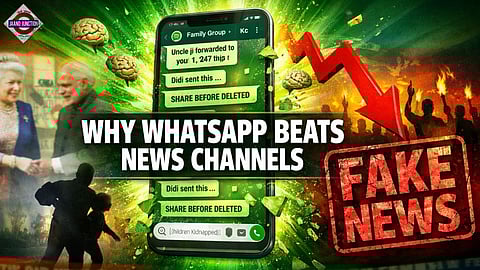

Uncle ji from the family group sends a message at 8:47 PM: "British Queen Elizabeth secretly visited India last week, PM welcomed her personally. Share before they delete!" Attached: blurry photo, three crying emojis, forward count 1,247. By 9:15 PM, 27 relatives have forwarded it to 300 others. Next morning, BBC says nothing happened. But uncle ji still swears "mummy ne bheja tha toh sach hoga". This isn't a one-off — it's how half of India gets its "news".
In a country where 500 million+ use WhatsApp daily, forwards outpace TV ratings and news apps combined. During elections, health scares, stock tips or communal rumours, family-group bulletins spread faster than any breaking news alert. Why? Because when "Didi forwarded it", trust bypasses fact-check entirely. News channels scream headlines; WhatsApp whispers secrets. And secrets always feel more real.
WhatsApp isn't just messaging — it's India's parallel news ecosystem, with 100 million+ daily forwards during peak rumour seasons. A 2023 study found 62% of Indians get political info from family chats first, ahead of TV (54%) or apps (28%). Here's why forwards win:
Emotional trust over institutional trust: Mummy/Didi/Chacha won't lie. Arnab or Ravish might have "agenda". When Reuters debunks a story, uncle ji replies: "Western media conspiracy".
Speed + secrecy: Forwards arrive 30 minutes before TV debates. Plus, the "SHARE BEFORE DELETED" watermark creates urgency — exactly like clickbait, but personal.
Customisation for every bubble: Your family's political slant shapes the forwards. BJP voter gets "Muslim population bomb" stats. AAP fan gets "Adani corruption files". Same app, parallel realities.
Result? During COVID, vaccine rumours killed more trust than viruses. In 2024 elections, 78% of deepfakes spread via WhatsApp first.
Science explains the addiction. A 2024 IIT study on Indian users found forwards trigger three brain hacks:
1. Confirmation bias on steroids: We share what matches our worldview 6x faster than contradictions. Uncle ji's "economic collapse tomorrow" forward? Instant triple-forward if he's already anti-govt.
2. Illusory truth effect: Repeated forwards make lies feel factual. See "British Queen visited India" 17 times from 9 relatives? By forward #18, it becomes "memory".
3. Social proof: 1,247 forwards = crowd wisdom. If everyone is sharing, it must be true. Never mind that 1,247 includes 900 bots and panic-forwarders.
News channels fight this with "verified" badges. Forwards fight with "Mummy verified it personally".
Lynching spikes: 2022 Muzaffarpur child-lifting rumours (WhatsApp origin) led to 3 deaths in 48 hours.
Stock crashes: "SEBI exposing Adani fraud" forwards tanked shares 8% before deletion.
Election deepfakes: 70% of viral Rahul Gandhi "Pakistan surrender" videos traced to family groups.
TV news gets blamed for polarisation. WhatsApp delivers it door-to-door.
Good news: You can fight back without family fights. Here's the 30-second checklist Indians actually use:
Reverse image search: Upload photo to Google Lens. 80% of forwards fail instantly.
Forward counter: Above 50? Red flag. Real news doesn't need chain letters.
URL check: TinyURL links? Don't click. Paste in Note app first to reveal destination.
Two-source rule: If it's real, multiple news-outlets like Jaano junction, NDTV and Republic will cover it within 2 hours.
Apps like Grok or Perplexity now debunk forwards in Hindi instantly. But habit change? That's harder than UPI adoption.
WhatsApp's power comes from being human-first. News feels like homework; forwards feel like gossip over chai. Legacy media's fix isn't better graphics — it's stealing the intimacy.
Some outlets are trying: The Quint's "Uncle ji fact-check" series went viral. Dhruv Rathee's WhatsApp debunk Reels hit 10M views. But scale remains the killer. One newsroom vs 500 million family groups.
Until news feels as personal as "Didi ne bheja hai", forwards will rule. And India will keep believing what it wants to believe — one forward at a time.

