
Patna, September 5, 2026: What brings more than 200 people from across South Asia to Patna for two days of psychotherapy?
In this case, the answer is a man who has spent decades studying what happens inside the human mind — and who can move, almost effortlessly, from psychoanalysis to love, from Gen Z's identity crisis to Urdu poetry, and from the complexities of modern relationships to stories about his own family.
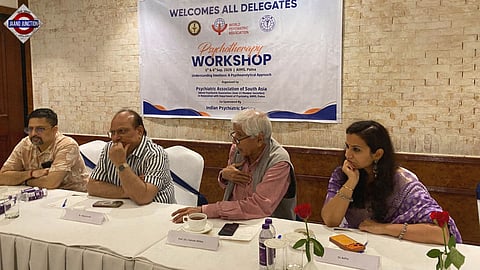
Eminent psychoanalyst, psychiatrist, author and poet (Prof.) Dr. Salman Akhtar is in Patna this weekend for an intensive two-day psychotherapy workshop, “Understanding Emotions: A Psychoanalytical Approach”, being organised by the World Psychiatric Association (WPA), Zone 15, in collaboration with the Department of Psychiatry at AIIMS Patna.
The workshop, being held on September 5 and 6, has drawn more than 200 applicants from across India and South Asia; an unusual level of interest for a specialised programme centred on psychotherapy and psychoanalysis.
But perhaps the attraction is not difficult to understand.
Dr. Akhtar has spent a lifetime making the complicated language of the human psyche accessible through stories, literature and everyday human experiences. Professor Emeritus at Jefferson Medical College and a Training and Supervising Analyst at the Psychoanalytic Center of Philadelphia, he has authored and edited hundreds of publications and written extensively on subjects ranging from personality and childhood trauma to immigration, identity, relationships and suffering.
His book Immigration and Identity, The Book of Emotions, Psychoanalytic Listening and Tales of Transformation: A Life in Psychotherapy and Psychoanalysis reflect a career that has consistently crossed the boundaries between clinical practice, culture and the ordinary experiences of being human.
And during an exclusive interaction with Jaano Junction, Dr. Akhtar showed exactly why that intersection remains so fascinating.
Talking about love and relationships, Dr. Akhtar offered a deceptively simple piece of advice.
“If your lover says, I give you my 100%, please ask your lover to keep at least 28% for yourself,” he said, explaining that retaining a part of one's own identity is essential for a relationship to survive.
For Dr. Akhtar, loving somebody and needing somebody are not necessarily the same thing; a distinction that becomes particularly relevant in an age where relationships are increasingly shaped by digital intimacy, instant communication and the culture of swiping.
He also reflected on modern dating and the ways in which technology has changed how people meet, choose and discard potential partners.
The swipe may be quick. Human emotions, he suggested, are not.
That idea runs through much of Dr. Akhtar's work: emotions cannot simply be sorted into convenient categories. Love can coexist with anger. Attachment can produce anxiety. The desire for closeness can exist alongside the need for independence.
It is precisely these contradictions that his Patna workshop is set to explore through emotions such as love, pain, rage, hate, guilt, forgiveness and hope.

But Dr. Salman Akhtar's conversation with Jaano Junction went beyond the consulting room.
Speaking about the identity crisis among today's Gen Z, he posed a question that was less about psychology and more about cultural memory:
“Hum kitne Hindustani hain?”
His concern was not that young Indians are attracted to Western culture. That, he stressed, is not inherently wrong.
The problem, he suggested, begins when familiarity with global popular culture comes at the cost of knowing one's own cultural roots.
A young person may know who Elton John or Michael Jackson is, he observed, but may not know Pandit Bhimsen Joshi, Kishori Amonkar or the significance of Raag Dhrupad. They may recognise Western cultural references but know little about why Sanchi is significant, why Amaravati is historically important, or who figures from India's own artistic and intellectual history were.
'Knowing Michael Jackson is not the problem. Forgetting Bhimsen Joshi is.'
Dr. Salman Akhtar drew an interesting parallel with the American expression “ABCD” — American-Born Confused Desi.
His contemporary Indian version? “IBCD — Indian-Born Confused Desi.”
It was his way of describing a generation negotiating multiple cultural identities at once; global enough to consume everything from Hollywood to K-pop, but sometimes disconnected from the cultural vocabulary immediately around them.
And perhaps that is where his psychoanalytic and cultural observations meet.
Identity, after all, is not simply about what we consume. It is also about what we remember.
For Dr. Salman Akhtar, questions of identity are hardly abstract.
He comes from one of India's most distinguished literary families.
His father, Jan Nisar Akhtar, was a celebrated Urdu poet and film lyricist, while his brother Javed Akhtar is one of India's best-known poets, lyricists and screenwriters. The family lineage extends across generations of writers and poets.
During his interaction with Jaano Junction, Dr. Salman Akhtar spoke warmly about his family and his brother.
He had met Javed Akhtar just around three days before the interaction. Yet, despite their closeness, getting the whole family together has become increasingly difficult.
The reason is almost painfully modern: everyone is scattered across the world.
The irony is striking. A family whose members made their lives through words, poetry and stories now struggles to find the time and physical space to sit together.
Dr. Salman Akhtar also spoke about the family's relationship with religion and identity, recalling its diverse cultural inheritance with the line:
“Some are born Hindus, some are born Muslims… hamare parivar ka dharma hi Shayar hona”
It is a particularly revealing statement coming from someone who has spent much of his professional life thinking about identity, belonging, migration and the psychological consequences of cultural displacement.
Perhaps what makes Dr. Salman Akhtar unusual is that he doesn't speak about the human mind only in the vocabulary of psychiatry.
He speaks about it through poetry too.
An accomplished poet himself, Dr. Salman Akhtar has published poetry in both English and Urdu, alongside his extensive psychoanalytic writing.
During his conversation with Jaano Junction, he shared shayari of his own as well as poetry associated with his late father, Jan Nisar Akhtar. That literary inheritance is not merely a footnote to his career. It appears deeply intertwined with the way he thinks about people.
For someone who studies emotions professionally, poetry becomes another language for understanding them. And perhaps that is why a conversation with Dr. Salman Akhtar can begin with psychotherapy and end with a couplet.
The workshop itself carries the theme “Circle of Hope”, reflecting the organisers' larger attempt to place human emotions and relationships at the centre of psychiatric care.
The programme is being supported by WPA Zone 15 early-career psychiatrists Dr Astha Sharma, Dr Nihal, Dr Kashyapi and Dr Aparna, with World Psychiatric Association South Asia's Dr Vinay Kumar and AIIMS Patna's HOD and organising chair Dr Pankaj associated with the programme.
For the participants arriving from different parts of India and South Asia, the two days offer an opportunity to engage directly with one of contemporary psychoanalysis' prominent voices.
But for Patna, there is something else happening.
A city more commonly associated with civil services, politics, education and its rapidly evolving startup and cultural ecosystem is, for two days, becoming a meeting point for conversations about the inner lives of people.
And Dr. Salman Akhtar seems particularly suited to that setting.
Because his central subject is not really psychoanalysis.
It is people – why they love, why they hurt, why they hold on, why they let go, why they become confused about who they are, and why, despite everything, they continue to search for hope.
This weekend in Patna, more than 200 people have come looking for some of those answers.
And Dr. Salman Akhtar has arrived with questions of his own.
