
When a woman finds the courage to leave, who asks how her children will survive the silence? Can a mother, herself wounded, alone heal the invisible scars that linger for both her and her child? or will we, as a society, move beyond commentary?
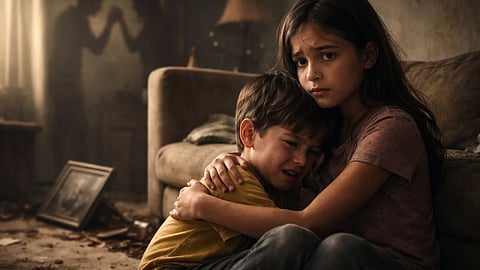
In the folds of ordinary lives, there lie the rips that shape generations. I met two children who walked into my home for tuition and inadvertently, into my conscience. Their story was not unfamiliar. A mother seeking khula from a husband who had long traded love for violence. In Islamic terms, khula refers to a woman’s legal right to initiate divorce. But it was the children’s silence that spoke volumes. Their eyes were empty, their laughter absent. They were not merely adjusting to a separation they were surviving a war waged behind closed doors. Innocence floated freely like a bubble shimmering with its rainbow colours until a sudden wind blew and it burst. For weeks they sat, eyes fixed on their notebooks as if the paper could hold what they could not speak. Small jokes, casual questions, a shared snack: these were the slow levers that eased the lock around their words. And then one afternoon their silence broke, a six-year-old with tears streaming down his face because he had watched his mother being beaten, and an older sister of only a few years trying, and failing, to hold him together. When they finally told me what their home had become, words failed me. I became as silent as they once were stunned, helpless, determined to listen. This is not an isolated case. It is a reflection of a deeply internalised dysfunction, one that cuts across regions, religions, and registers of privilege. Domestic violence is not confined to news headlines or legal statistics. It is lived daily in middle-class homes, in educated circles, behind the façade of “good families.” And when children are caught in the crossfire, the damage is always permanent.
What keeps this cycle moving is normalisation: the muttered “ghar ki baat hai,” the impatient retort that “bachche samajhdar ho jaate hain,” the neighbourhood that looks the other way. They grow up guarded, mistrustful, anxious. The home meant to be their sanctuary becomes their battleground. Over time, the chaos of their childhood calcifies into adult insecurities, relationship dysfunctions, or worse, replication of the very violence they once feared. This trauma does not end with them. It is passed down quietly to generations. Unnoticed, untreated, and often unnamed, these wounds create families that function mechanically but feel nothing. A generation emotionally adrift because no one asked, “Are you okay?”
Institutions especially schools must shoulder a part of this responsibility. It is not enough to preach discipline and grades. We need trained counsellors, sensitised teachers, and above all, safe spaces where children can speak without fear of judgement. The National Education Policy (NEP) may speak of holistic education, but without emotional literacy, even the brightest minds can be dimmed. We must redefine strength not as silent endurance but as the courage to seek help.
Policymakers, too, must move beyond reactionary laws and adopt preventive frameworks. Mental health must find equal priority in child welfare policies. Divorce courts should mandate family counselling.
Those siblings I once met now smile again. Not always. Not effortlessly. But it is enough to remind me that small acts of attention, of patience, of belief can nurture emotional recovery.
To say that domestic abuse creates dysfunctional families is not hyperbole, it is an institutional truth. In an age where performative concern floods social media, perhaps the most radical act is sincere, sustained care.
There is no single remedy. But there is a starting point.
Ask. Listen. Intervene.
Views expressed in Citizen Junction stories are that of the author and solely of the author, submitted to Jaano Junction through WRITE. Start writing on Jaano Junction to get your opinion published. Click Here to start your citizen journalism journey.

