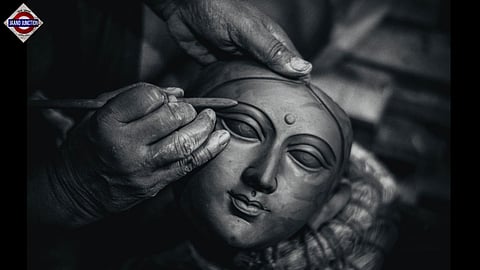

In Bangla, the phrase 'maati hoye gelo' is often used to imply that something has been ruined. This year, maati (soil) has emerged as the biggest threat looming over Durga Puja in Bengal - the state's biggest festival. A shortage of a specific kind of soil collected from the banks of the River Ganga due to a ban on digging and strict enforcement by the police under a new BJP administration has sparked anxiety among artisans in Kumartuli, Kolkata's famed potters' locality. This soil is indispensable to crafting Durga idols. Without it, the festival may well become 'maati hoye galo'.
At this time of the year, the narrow lanes of Kumartuli, which houses over 200 potter families and around 600 workshops, come to life as artisans start preparations for the Durga Puja. However, with the festival just four months away, Kumartuli has come to a standstill. At the heart of the silent crisis that has gripped the artisans is the availability of 'entel mati' or sticky black clay. Now, this clay used to be specifically collected from the Ganga banks in Raichak, Jibantala, and Diamond Harbour. It was then supplied to the artisans. A supply chain was in place.
Now, since digging soil from riverbanks has long been banned, people associated with this supply chain mostly ran the operation illegally. Large amounts of clay used to come from Canning and Diamond Harbour, situated on the eastern banks of the River Hooghly, a tributary of the Ganga.
The BJP has previously alleged that this network used to be managed by TMC goons who engaged in illegal sand mining. However, with a new BJP government in place and a crackdown on criminal syndicates by the Suvendu Adhikari administration, the supply chain has collapsed. None of them secured a proper licence. The previous Trinamool Congress government turned a blind eye to this.
"Anyone going to collect the soil is being treated like a thief. The potters' association are in contact with the BJP government. There should be some relaxation for us. So many idols need to be made," Dilip Pal, an artisan, told IndiaToday.in. A Durga idol set can take anywhere from two weeks to a month to be made, depending on the detailing required.
The work on crafting the idols usually starts after March. First, idols of Saraswati and Lakshmi, the two daughters of Durga, are made. The craftsmen from Kumartuli produce over 4,000 idols every year. Additionally, hundreds are shipped to foreign countries as well.
Due to the complex nature of crafting a Durga idol set - depicting the goddess slaying Asura alongside her children - a specific type of smooth clay is required. As mentioned previously, this is called 'entel mati' or Ganga mati. This is so because it is extracted from the beds of the Ganga.
In keeping with age-old rituals, this clay is mixed with punya maati (sacred soil) collected from 'nishiddho palli' or a red-light area. Traditionally, this soil was collected from the doorstep of a sex worker's home. The tradition is, however, now on the wane.
Since 'entel mati' is smooth, it is used to make a finer layer to give shape to the idol. This clay is an indispensable ingredient used in handcrafting Durga idols. Any other clay gets hard quickly and cannot be given shape easily.
No matter which state these idols are made in, the artisans from Kumartuli carry the 'entel mati' with them to be used for the finishing of the idols.

The crisis has left Kumartuli's artisans deeply anxious. It is not just about tradition, but also their livelihood. The earnings from these few months sustain them and their families for the rest of the year.
Additionally, another key ingredient - jute - which used to come from Bangladesh, has stopped. Jute fibres are kneaded into the clay to make it sturdy yet pliable. It is also used to bind the foundation skeleton.
Last year, India banned imports of jute and ropes from Bangladesh through all land routes amid strained ties under the Muhammad Yunus administration. While relations have improved under Tarique Rahman, the curbs have not been eased. It has caused domestic prices to soar from Rs 5,600 per quintal to Rs 12,000-13,000 per quintal.
A shortage of raw material has also led local jute millers in Bengal to suspend operations or shut shop.
On Thursday, a delegation of artisans, led by Padma Shri awardee Sanatan Rudra Pal, met BJP MLA Swapan Dasgupta. Dasgupta amplified their concerns on X, urging an intervention by Chief Minister Suvendu Adhikari.
"The supply of the Ganga soil that is indispensable in the crafting of the Devi has abruptly stopped. Unless the supply is resumed immediately, the state will face a problem during the forthcoming Durga Puja," the former Rajya Sabha MP tweeted.
The Canal East Road Artisans Organisation, an umbrella body of potters, has also written a letter to the chief minister.
"The places from where we used to collect the clay for idol-making have completely stopped allowing soil excavation. This has severely disrupted our work. Many artisans and labourers are facing financial hardships," the letter said. The organisation asked Suvendu to consider the matter from a humanitarian perspective.
Shyamal Pal, a member of the organisation, said a truck-load of the soil used to be sold to the artisans for anywhere between Rs 12,000-15,000.
"Previously, we used to get the soil at our doorstep. This was sold by TMC middlemen. We had no problems in all these years," he told, Pal said the government has assured them that it would look into the matter urgently.
Swapan Dasgupta blamed the Trinamool for the crisis, suggesting irregularities in the manner in which the soil was procured.
"The artisans used to get it from some suppliers, who, in turn, sourced it from Diamond Harbour and Canning. There used to be some irregularities in how the soil was procured under the previous TMC regime. Now that has been choked off. It is why they are facing the crisis," the BJP MLA told IndiaToday.in. Dasgupta said he has urged the government to urgently look into the matter.
Urgency is now the need of the hour. Dilip Pal said the May-June period is crucial as bulk orders start pouring in. In the weeks before the onset of monsoon, workshops in Kumartuli operate day and night to meet the demand. Once the rains arrive, work inevitably slows down as the idols need sufficient sunshine to dry.
However, this year, with artisans grappling with an acute shortage of the very essential ingredient for crafting Durga idols, a cloud of uncertainty hangs over Bengal's biggest festival and the livelihoods tied to it.
