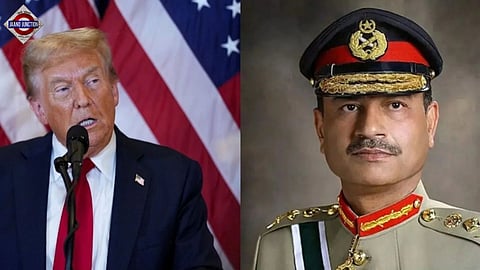

US President Donald Trump’s public warmth towards Pakistan Army chief General Asim Munir, including describing him as his “favourite field marshal”, is increasingly at odds with concerns emerging within sections of the US national security establishment over the general’s reported links with Iran’s military leadership.
Reports from Fox News and inputs from intelligence circles indicate that officials and regional analysts view these ties as a potential red flag, particularly as Munir is seen to be operating as a backchannel between Washington and Tehran.
General Munir is playing a key backchannel mediator between Washington and Tehran. However, critics argue that this positioning is complicated by his reported long-standing proximity to senior figures within Iran’s Islamic Revolutionary Guard Corps (IRGC).
Retired Pakistani General Ahmed Saeed told Fox News Digital that Munir maintained personal relationships with prominent Iranian military figures, including the late Quds Force commander Qassem Soleimani and IRGC commander Hossein Salami. These reported ties have led some officials to view his diplomatic utility with caution, with concerns that his dual access to both US and Iranian channels could present strategic risks.
Much of the current scepticism is rooted in longstanding concerns within US policy circles about Pakistan’s role in regional security dynamics, particularly during the Afghanistan conflict. Critics have repeatedly described Islamabad as an unreliable partner, citing allegations that it received significant US assistance while simultaneously tolerating or enabling Taliban-linked networks.
Analysts at the Foundation for Defense of Democracies (FDD), including senior fellow Bill Roggio, have warned that Pakistan’s military establishment should be assessed cautiously given its historical behaviour and evolving regional alignments. They argue that Islamabad’s position as a potential intermediary in US-Iran engagement does not necessarily guarantee alignment with American strategic interests and may instead introduce additional layers of complexity in an already volatile region.
Roggio has warned that Pakistan’s past conduct in Afghanistan should inform current policy calculations, arguing that its reliability as a security partner has been inconsistent and at times contradictory.
For US policymakers, the situation presents a delicate balancing act – reconciling President Trump’s personal rapport with General Munir against broader reported intelligence concerns regarding Pakistan’s regional relationships, particularly its reported links to Iran’s military establishment.
As geopolitical tensions continue to evolve across the Middle East and South Asia, debate persists over whether Munir represents a useful diplomatic conduit or a potential strategic liability in US foreign policy calculations.

