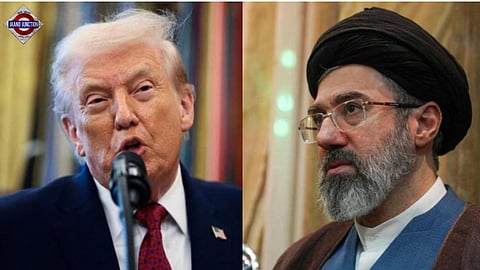

US President Donald Trump on Sunday claimed that a peace-related agreement involving the United States, Iran and several Middle Eastern countries had been “largely negotiated."
At the same time, Iran’s Revolutionary Guard Corps (IRGC) described Trump’s remarks as “propaganda" and insisted that Tehran’s nuclear programme had not even been discussed at this stage.
In a lengthy post on Truth Social, Trump said he had held calls from the Oval Office with leaders of Saudi Arabia, the United Arab Emirates, Qatar, Pakistan, Türkiye, Egypt, Jordan and Bahrain regarding what he described as a “Memorandum of Understanding pertaining to PEACE."
He added that an agreement involving the United States, Iran and the participating countries was close to completion.
“An Agreement has been largely negotiated, subject to finalization between the United States of America, the Islamic Republic of Iran, and the various other Countries," Trump wrote, adding that “final aspects and details" were still under discussion and would be announced shortly.
He also said he had separately spoken with Israeli Prime Minister Benjamin Netanyahu and claimed that the call “likewise, went very well."
One of the key outcomes Trump mentioned was the reopening of the Strait of Hormuz, the crucial global shipping route whose disruption has rattled energy markets and intensified geopolitical tensions in recent months.

IRAN DISMISSES TRUMP’S CLAIMS
Iran, however, swiftly disputed Trump’s characterisation of the talks.
According to Al Jazeera, Iran’s Fars news agency, quoting the IRGC, said Trump’s latest social media post was aimed largely at domestic political messaging and did not reflect the reality of ongoing discussions.
“It is worth mentioning that Trump had previously announced negotiations about Iran’s nuclear programme as one of the main and inseparable conditions of any agreement. However, no commitment has been made by Iran, and the nuclear issue has not been discussed at this stage," Fars reported, citing the Revolutionary Guard.
The report further quoted Iranian officials as saying that American authorities themselves had conveyed that Trump’s public statements were often intended for “promotional and media consumption purposes within the United States."
Iranian Foreign Ministry spokesperson Esmail Baghaei also maintained that Tehran’s immediate focus remained on ending the war and securing sanctions relief, not negotiating its nuclear programme.
AP reported that Baghaei described the proposal as a “framework agreement" under which broader details could be discussed over the next 30 to 60 days.
RUBIO SIGNALS POSSIBLE BREAKTHROUGH
US Secretary of State Marco Rubio suggested that negotiations were still fluid but acknowledged that progress had been made.
Speaking to reporters during his India visit, Rubio said there was a possibility of developments “later today, tomorrow, in a couple of days."
“The President’s preference is always to solve problems such as these through a negotiated diplomatic solution," Rubio said, while reiterating Washington’s long-standing position that Iran “can never have a nuclear weapon."
Rubio also repeated US demands that the Strait of Hormuz be reopened “without tolls" and that Iran surrender its highly enriched uranium stockpile.
STRAIT OF HORMUZ AT CENTRE OF TALKS
The Strait of Hormuz has emerged as a central issue in the negotiations after Iran effectively disrupted shipping through the passage following the outbreak of conflict earlier this year.
Reuters reported that the proposed framework could unfold in three phases: formally ending the war, resolving the crisis in the Strait of Hormuz, and beginning a broader negotiation window on long-term issues, including Iran’s nuclear activities.
Reuters quoted Fars news agency as saying Trump’s suggestion that an agreement was nearly complete was “inconsistent with reality."
AFP also reported that Iranian officials acknowledged a “trend towards rapprochement" but warned that significant gaps remained between the two sides.
IRAN WARNS AGAINST FRESH US STRIKES
Even as diplomatic efforts intensified, Iranian leaders issued fresh warnings against any renewed military action by Washington.
Iranian Parliament Speaker Mohammad Bagher Ghalibaf said Tehran had rebuilt its military capabilities during the ceasefire and warned that if the US resumed attacks, the consequences would be “more crushing and bitter" than at the beginning of the conflict.
The latest developments come after weeks of indirect negotiations following the conflict that erupted after US and Israeli strikes on Iran earlier this year.
Despite repeated claims of progress, negotiators on all sides continue to acknowledge that major differences remain unresolved.
Source: News18
