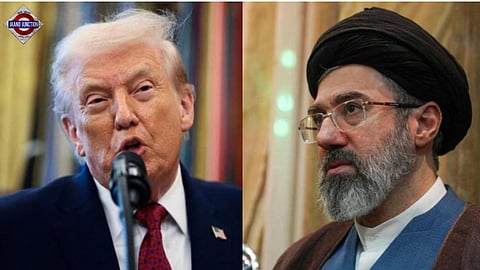

Hours after Iran conveyed its response to the US peace proposal through Pakistan, President Donald Trump publicly rejected Tehran’s reply, calling it “totally unacceptable” and signalling that any diplomatic opening between Washington and Tehran remains fragile.
Taking to Truth Social, Trump wrote: “I have just read the response from Iran’s so-called ‘Representatives.’ I don’t like it — TOTALLY UNACCEPTABLE!”
Despite backchannel communication remaining active, Trump made it clear he saw little merit in Iran’s latest position.
With that, any possible opening in the US-Iran standoff appeared to narrow further. Earlier on Sunday Prime Minister Shehbaz Sharif confirmed that Tehran had conveyed its response to Donald Trump’s latest peace proposal through Islamabad.
Iranian state television reported that Iran rejected the latest US proposal to end the war, describing the offer as equivalent to surrender. The report suggested Iran viewed the American proposal as heavily one-sided and unacceptable under the current conditions.
Iran's response centred on ending the conflict across the region, particularly in Lebanon, and ensuring safe passage through the Strait of Hormuz, though officials stopped short of explaining when or how the critical shipping route could reopen, Iranian state media reported. The response came after the US proposed ending the fighting first before moving on to more divisive issues such as Iran’s nuclear programme.
Instead of opening the door to diplomacy, Trump warned that the US could finish off every remaining Iranian target within two weeks.
In a television interview aired Sunday, Trump said that Iran had already suffered a major defeat. Even so, he indicated that Washington was prepared to expand military operations if negotiations collapsed, saying the US had completed "probably 70 per cent" of its intended targets inside Iran and could quickly move against the rest.
He also doubled down on his threat regarding Iran’s stockpile of enriched uranium, which is one of the biggest obstacles in negotiations aimed at ending the 10-week conflict involving the US, Israel and Iran.
Trump claimed that the US was maintaining constant surveillance on the stockpile, warning that any movement near the site would be immediately detected by Washington.
“We have it surveilled... If somebody walked in, they can tell you his name, his address, and the number of his badge,” Trump said, before issuing a stark warning: “If anybody gets near the place, we will know about it, and we’ll blow him up.”
The comments came amid continuing uncertainty over the whereabouts of Iran’s uranium stockpile, which international reports say may still be buried beneath nuclear facilities bombed by the US in June 2025. Tehran has not publicly confirmed where the material is located.
Iran is estimated to possess more than 400 kilograms of uranium enriched to 60 percent purity. Experts say uranium enriched to around 90 percent can potentially be used in nuclear weapons. The US President has demanded that Iran move its enriched uranium stockpile out of the country and fully dismantle its enrichment programme. Tehran, however, has maintained that uranium enrichment is a sovereign right under international law and has rejected pressure to hand over its nuclear material.
In another lengthy Truth Social statement, he accused former President Barack Obama of empowering Iran through the 2015 nuclear agreement formally known as the Joint Comprehensive Plan of Action, or JCPOA. The US President also claimed Iran had spent decades "playing games" with Washington and accused previous US administrations of weakness.

The JCPOA agreement had capped Iran’s uranium enrichment at 3.67 per cent in exchange for sanctions relief and international economic access. Trump withdrew the US from the deal during his first term and restored sanctions, arguing the agreement failed to permanently stop Tehran from pursuing nuclear weapons capability.
Last month, Trump claimed Iran had agreed to let the US retrieve the uranium and transport it back to America. Tehran quickly denied the assertion.
"Enriched uranium is as sacred to us as Iranian soil and will not be transferred anywhere under any circumstances," Iranian Foreign Ministry spokesperson Esmaeil Baghaei said at the time.
Although a ceasefire formally took effect last month, tensions across the Gulf have lingered volatile, with repeated flare-ups near the Strait of Hormuz and Iranian ports. The US and Iran have continued to enforce a naval blockade on Iranian-linked shipping.
