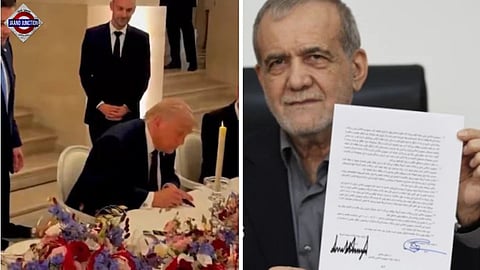

US President Donald Trump and Iranian President Masoud Pezeshkian have formally signed a memorandum of understanding (MoU) aimed at ending the conflict between the two countries, marking a major diplomatic breakthrough after months of hostilities.
According to US and Iranian officials, the document was digitally executed by both presidents on Wednesday after being initially signed electronically on Sunday by US Vice President JD Vance and Iran's chief negotiator Mohammad Baqer Qalibaf. The agreement took effect immediately, replacing plans for a formal signing ceremony in Switzerland later this week.
President Donald Trump has also officially signed a hard copy of the US-Iran agreement during tonight’s dinner at the Palace of Versailles, according to a US official. The White House has also published a video of the signing with the French President Emmanuel Macron by his side at the dinner table.
President Trump told reporters he signed the Iran memorandum of understanding in Versailles as he departed the palace following a dinner with French President Emmanuel Macron.
A White House official says a photo of the signed agreement was sent to Iran and the mediating countries, to formally put the deal into effect.
US officials said the MoU is intended to end the nearly four-month conflict and facilitate the reopening of the Strait of Hormuz, a vital global energy shipping route.
While negotiating teams remain scheduled to gather in Geneva, Iranian officials said Friday's meeting in Switzerland is not intended for signing the agreement and a final decision on whether it will take place is expected within hours.
This also indicates that the digital execution of the document means no physical signing ceremony will be held in Switzerland.
Iran's Foreign Ministry spokesperson Esmaeil Baghaei said Tehran must be able to sell its oil without restrictions on transportation or insurance and receive revenues from those sales. He said the United States has committed to removing obstacles to Iran's access to frozen funds.
Baghaei added that oil-related sanctions should be lifted immediately, allowing Iran to resume oil exports during a 60-day period in which the parties will negotiate the final terms of a broader agreement.
Iran said the MoU establishes a 60-day framework during which neither side should take actions that undermine the agreement. According to Baghaei, the other party should refrain from imposing new sanctions or increasing military deployments in the region during that period.
He described the arrangement as a "commitment in exchange for commitment" and said negotiations on enforcement mechanisms would begin immediately.
Baghaei said Iran's enriched uranium would remain inside the country and would not be transferred abroad. He said one option under discussion is the dilution of enriched uranium.
Iranian officials emphasized that the Farsi and English versions of the agreement contain similar provisions and have been signed by both sides.
Iran ruled out any negotiations over its missile programme or broader defense posture.
Baghaei said Iran's missiles are "only meant to be fired, not negotiated," while stressing that the country's defensive capabilities would not be discussed with any party as part of the current process.
Iran's top negotiator Mohammad Baqer Qalibaf said the Strait of Hormuz would not return to pre-war conditions, though Tehran would continue to operate within international law and maritime navigation rules.
He said Iran would charge fees for services provided to vessels transiting the strategic waterway. Iranian officials also noted that responsibility for the strait rests with Iran and Oman.
Qalibaf said the MoU includes provisions for approximately $300 billion in investment in Iran, with part of the funds earmarked for reconstruction projects following the conflict.
Speaking to reporters in Paris, Trump said it would be unfair for Iran to be denied ballistic missiles if other countries in the region possess them.
"If Saudi Arabia and Qatar, and they all have some, I would say in relative proportion, I think it's okay," Trump said.
The US president also indicated that American military forces would remain in the Gulf "for a while" despite the agreement, suggesting Washington intends to maintain a security presence as the implementation process unfolds.
Pakistan Prime Minister Shehbaz Sharif announced that the “Islamabad Memorandum of Understanding” between the United States and Iran was electronically signed and has entered into force with immediate effect.
In a post on X, Sharif said the agreement was signed by the presidents of both countries and endorsed by Pakistan in its role as mediator. He described the accord as a demonstration of both sides’ commitment to resolving the conflict through diplomacy.

According to Sharif, the first steps under the memorandum include Iran’s immediate reopening of the Strait of Hormuz and the United States lifting its naval blockade. He said the measures are intended to help de-escalate tensions and pave the way for a broader diplomatic settlement.
Source: India Today
