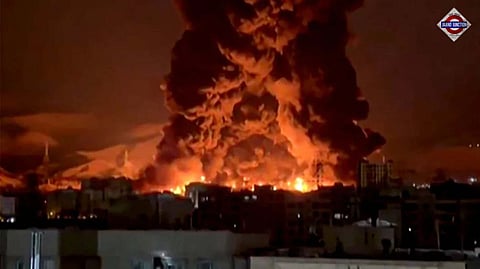

The United States and Iran on Saturday exchanged fresh attacks for a seventh consecutive night, with Tehran claiming US strikes killed three people in southern Iran while its forces retaliated by targeting American military sites in Kuwait and Jordan, further widening the Middle East conflict.
Iran’s state news agency IRNA reported that three people were killed and eight others wounded in the southern province of Hormozgan following US attacks.
At the same time, Iran’s army said it had launched strikes on US military targets in Kuwait and Jordan in response to the American offensive.
According to Iranian state media, the attacks in Kuwait targeted an ammunition depot at the Al-Adiri camp, headquarters buildings and ammunition depots at the Ali Al-Salem base, as well as several communication bridges. In Jordan, Iranian forces reportedly struck fuel tanks at the Al-Azraq base.
The latest escalation came as US Central Command said its forces were carrying out attacks intended to “continue degrading Iranian military capabilities," according to a statement shared on X.
Iran accused the United States of broadening its campaign by striking civilian infrastructure, including an airport, a railway station and two bridges. While US President Donald Trump had previously threatened to target Iranian infrastructure, Washington has not officially confirmed attacks on such civilian sites.
Adding to the tensions, Iran’s Revolutionary Guards said two oil tankers exploded after hitting mines in the Strait of Hormuz, alleging they had been directed by “deceptive American intelligence agencies." The US military denied the accusation.
The Guards also claimed they had “stopped" four ships attempting to transit the strategic Strait of Hormuz, a critical global oil shipping route that has become a flashpoint since the conflict reignited.
Major General Mohsen Rezaei, a senior military adviser to Iran’s supreme leader, warned that Tehran would resume “full-scale offensive operations" if US attacks continued for another two or three days.
“Iran will no longer limit itself to retaliatory, like-for-like responses…and no political border will be safe," Rezaei was quoted as saying by Iranian news agency IRIB.
The current war began on February 28 after deadly US-Israeli strikes on Iran. Tehran responded by effectively closing the Strait of Hormuz and launching attacks on Israel and American interests across the Gulf.
The conflict has also affected neighbouring countries. Kuwait said an Iranian strike damaged a power and water facility, while its military reported several soldiers were wounded in drone attacks on military bases.
Iran’s Revolutionary Guards further claimed they targeted US radar systems and military aircraft in Qatar to “punish the aggressor," though Doha said it intercepted a missile attack.
The Guards also announced strikes on two US radar sites in Oman and the Al-Tanf military base in Syria. A Syrian military source denied any attack on Al-Tanf, while US officials said American forces had already withdrawn from the base earlier this year.
In Iraq’s Kurdistan region, drone and rocket attacks killed nine members of the exiled Komala Party of Iranian Kurdistan, which blamed Iran for the strikes.
Iran’s health ministry said at least 38 people have been killed and more than 400 injured since fighting resumed.
As diplomatic efforts continued, China and Pakistan called on Washington and Tehran to halt hostilities and return to negotiations.
However, despite the renewed fighting, mediated talks between the two countries have not been formally called off.
Since the start of the conflict, the Strait of Hormuz has been a chokepoint with both states fighting over control of its maritime traffic. While the US and its allies have encouraged commercial vessels to use waters closer to Oman, Iran has insisted that ships follow routes designated by Tehran.

