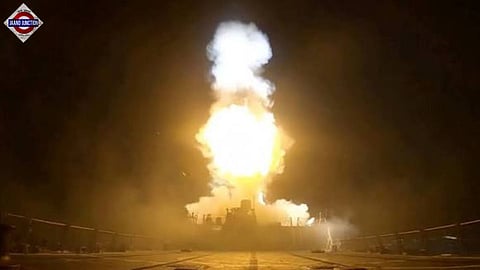

The US and Iran exchanged heavy fire for a sixth consecutive night on Thursday, with Washington stepping up airstrikes and Tehran retaliating with missiles and drones targeting American military bases across the region, signalling that last month's fragile truce has effectively collapsed.
While the US military said it launched fresh strikes to "further degrade Iranian military capabilities", Iran said it targeted American bases, including an expanded air base in Jordan that it claimed was used in a US strike on an Iranian children's cancer hospital a day earlier.
The US military said the latest operation, which began at 2 pm ET (1800 GMT), was intended to "further degrade Iranian military capabilities."
"US Central Command began conducting a new wave of strikes against Iran... to further degrade Iranian military capabilities," CENTCOM said in a statement.
Shortly after the announcement, Iranian state television reported that "American projectiles" struck areas in and around the southern port city of Bandar Abbas, home to Iran's largest commercial port and major naval and Islamic Revolutionary Guard Corps (IRGC) facilities overlooking the Strait of Hormuz.
Iran's semi-official Mehr news agency also reported strikes near the strategically located Qeshm Island.
Iranian media later reported additional US strikes on three bridges and the railway station in Bandar Khamir, as well as Iranshahr Airport in southeastern Iran.
The death toll from a US strike on Bandar-e Khamir Bridge rose to seven, with nine others injured, according to Iran's semi-official Fars news agency.
Despite the renewed fighting, the White House insisted Iran remains interested in negotiations.
"Iran very much continues to talk to the United States of America and express that they want to make a deal with us because they are suffering devastating blows on behalf of our US military," White House Press Secretary Karoline Leavitt told reporters.
Leavitt also defended the military campaign, saying President Donald Trump would not "sit by and allow these active acts of terrorism to take place in the strait without ensuring Iran pays consequences for that," while maintaining that the president "was always open to diplomacy."
Her remarks came as Tehran rejected Trump's claim that an American citizen had been released from Iranian custody as a goodwill gesture. Iran's judiciary said no US prisoner had been released or exchanged, according to state media.
HORMUZ SHIPPING CRISIS DEEPENS
The latest military exchanges have further disrupted shipping through the Strait of Hormuz, through which nearly one-fifth of the world's oil and gas supplies pass.
Iran has resumed efforts to tighten its control over the strategic waterway, while Washington has responded by blockading Iranian ports. Tehran has also warned it could encourage Yemen's Houthi rebels to target the Bab al-Mandeb Strait if the US expands attacks on Iranian infrastructure, Reuters reported, citing sources.
US officials say recent strikes along Iran's southern coastline are aimed at reducing Tehran's ability to threaten commercial shipping.
Iranian military spokesperson Brigadier General Mohammad Akraminia, however, said airstrikes would not weaken Iran's grip over the Strait of Hormuz, insisting the country could target the waterway from anywhere within its territory.
The renewed fighting has sent global energy prices higher and reignited concerns over the security of one of the world's most critical maritime trade routes.

