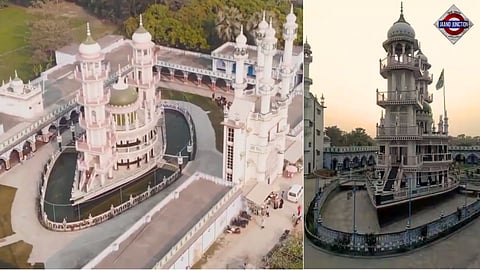

When your parents have the kind of job where you move every few years, you get used to being the naya bachha in town. You learn to pack fast, to make friends fast, and to say goodbye fast. When we first moved to Muzaffarpur, everything felt a bit unfamiliar. To break the ice and get to know our new home, my parents and I started this little tradition. On free weekends, we’d just hop into the car, pick a direction, and drive out into the dehat nearby without much of a plan.
It was on one of those random Sunday drives through Kanti that we saw something that made my dad tap the brakes.
We turned off NH-27 (the old NH-28) towards Kanti, driving down this narrow, dusty lane, surrounded by nothing but the usual green fields and open skies you see everywhere in North Bihar. It was peak afternoon and our old Swift was kicking up dust. Then, right out of nowhere, this massive white and green structure appeared. It didn’t look like a building. It looked exactly like the front of a giant kashti (ship), cutting right through the dirt.
We pulled over and just stared. There were no tourists around, no big signs, just this beautiful concrete boat sitting quietly in the middle of a village, shaded by a few neem trees.
We walked inside, and because I didn't have my camera on me, I just had to take it all in with my own eyes. We learned later from a few locals at a chai stall that this was the Kothiyan Mazar Sharif. They told us that back in the day, this whole area used to get flooded terribly during the monsoons. The Bagmati river would overflow and the village would turn into a total island, and the only way to survive or get food was by using small wooden boats. When they built the shrine for the buzurg (saint), they shaped it like a ship to remember that. It was their way of saying that just like a boat saved their lives during the floods, this place saves their spirit when life gets rough.
Stepping onto the "deck" of the mazar felt incredibly peaceful. The hulla-gulla from the main road completely died down. The air inside was heavy and sweet—it smelled like fresh roses mixed with that strong, comforting scent of agarbatti and ittar that sticks to your clothes long after you leave.
Because we were outsiders and newcomers to the district, we simply stood in a quiet corner and watched the aakeedat (devotion) of the local people. The entire atmosphere felt so completely simple and honest, without any show-off. You could hear the soft rustle of silk chaddars being gently unfolded by devotees, and the musical clinking of glass bangles as local women tied little mannat ka dhaga (threads of wishes) to the intricate latticework windows while whispering their deepest prayers.
What truly touched our hearts, though, was witnessing that real Ganga-Jamuni tehzeeb that keeps this place alive. Standing on that concrete deck, you couldn't tell who belonged to which community. You saw people from completely different faiths standing shoulder-to-shoulder, bowing their heads in respect, and sharing the exact same peaceful space with so much sukoon. In that moment, the concrete ship felt entirely level. It didn't matter where you came from or what your background was; everyone was welcome on board.
In today's world, people spend small fortunes and travel thousands of miles to visit famous, crowded monuments just so they can take photos for social media and tick a destination off a bucket list. But that quiet Sunday afternoon in Kanti taught our family a big lesson. It taught us that the most magical, unforgettable places on earth are usually the ones you stumble upon by pure accident, hidden away in the quiet corners of the map.
The ship at Kothiyan is a beautiful, living monument built out of local resilience, historical survival, and deep, shared human love. For a family like ours that is always moving from one government posting to the next, always unpacking in a new town, that quiet concrete vessel provided a beautiful reminder: you don't need an ocean to find a harbor, and you can find a true sense of ghar just about anywhere—even parked on the dry land of a quiet Bihar village.
Location: Kothiyan Mazar Sharif, Kanti, Muzaffarpur, Bihar (~20km from Muzaffarpur town)
Views expressed in Citizen Junction stories are that of the author and solely of the author, submitted to Jaano Junction through WRITE. Start writing on Jaano Junction to get your opinion published. Click Here to start your citizen journalism journey.

