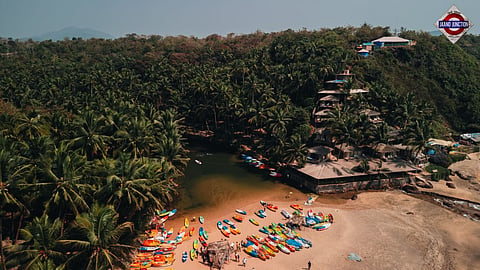

Where the Konkan Coast Meets My Memories – A Journey Through Goa, Karnataka and Kerala
Some journeys begin with a railway ticket or a packed suitcase. Some begin much earlier, in childhood memories, family stories and the names of places that we have heard all our lives. For me, a journey through Goa, Karnataka and Kerala is not simply a journey across three regions of India. It is a journey through language, food, faith, migration and memory.
I come from Dharmadam in Thalassery, Kerala, but my family memories also take me towards Goa, particularly Mangeshi, a place connected with my mother's ancestral roots. Whenever I travel through the Konkan region, I feel that I am not merely visiting another destination. I am walking through a landscape that has been part of my cultural memory for generations.
The journey from Kerala towards Karnataka changes gradually. The landscape, language and food begin to acquire new shades. The roads pass through green hills, villages and coastal settlements. Places such as Manjeshwaram, Mangaluru, Udupi and Karkala carry memories of communities that have travelled, settled and rebuilt their lives along the western coast.
Among these communities are the Konkani-speaking people. Their history is inseparable from migration. Konkani has travelled across Goa, Karnataka, Kerala, Maharashtra and other parts of India. It has survived because ordinary people carried it in their homes, conversations, songs, prayers and kitchens.
For me, language is perhaps the most intimate form of travel.
A person may leave a village, but the language of the home often travels with that person. Konkani travelled with families who moved southward. In Kerala, it found a new home while continuing to retain memories of Goa and the Konkan coast. This created a fascinating cultural meeting point between Konkani and Malayalam.
Food tells this story particularly well.
Traditional GSB Konkani dishes such as dalitoy, gheshi, valval, ambatt, bibbya upkari, modak, saatta, surnoli and godshe carry memories of another geography. Yet when Konkani families live in Kerala, their culinary world naturally encounters Kerala's own traditions—puttu, appam and stew, idiyappam, dosa, parotta and the elaborate Kerala sadya.
A kitchen can therefore become a map.
One can travel from Goa to Kerala without leaving the dining table.
Temples also form an important part of this cultural journey. From the temples of Goa to those of coastal Karnataka and Kerala, religious traditions have travelled along with people. Mangeshi in Goa remains especially meaningful to me because of my family connection. Further south, the temples of Mangaluru, Udupi, Karkala and Manjeshwaram reveal another chapter of the same long cultural journey.
But the Konkan coast is not a landscape belonging to one community alone.
Hindu temples, Christian churches and Muslim mosques stand within the same broader cultural geography. Markets, railway stations, fishing villages, schools and roadside restaurants bring people together every day. Languages overlap. Malayalam, Konkani, Kannada, Marathi, Tulu and English can all become part of the soundscape of a journey.
This multilingual character is one of the things I value most about travelling through this region.
A journey also changes the way we understand migration. Migration is often discussed through statistics, borders and historical events. But for an ordinary family, migration can be much simpler: a new house, a new school, a new market and a new language learned alongside the language brought from home.
The Konkani experience is therefore not only a story of displacement. It is also a story of adaptation and cultural continuity.
Goa remains an important centre of Konkani cultural memory, but Konkani life cannot be understood only through Goa. Karnataka and Kerala have their own Konkani histories. Mumbai and other cities have also become important spaces where Konkani-speaking people have lived, worked and maintained connections with their ancestral culture.
Whenever I travel, I am reminded that geographical distance does not necessarily weaken memory. Sometimes it strengthens it.
A place becomes meaningful not merely because of its monuments or scenery but because of the people and memories associated with it. A road through the Western Ghats, a temple bell, the smell of a traditional dish, a conversation in Konkani or Malayalam, or even an old family story can suddenly connect the present with a distant past.
That is why my journeys through Goa, Karnataka and Kerala are personal journeys.
I travel as a visitor, but I also travel as someone looking for fragments of a cultural story.
The most beautiful discovery is that such stories rarely belong to one person. They belong to families, communities and places. They cross generations and languages. They change slightly as they travel, but they do not disappear.
Perhaps that is the real meaning of a journey.
We travel to see places, but somewhere along the way, the places begin to tell us who we are.
And when I return to Dharmadam, I carry more than photographs and memories. I carry the sounds of Konkani and Malayalam, the tastes of Goa and Kerala, the roads of Karnataka, and the feeling that the Konkan coast is not just a geographical stretch on the western side of India.
For me, it is a living memory.
Views expressed in Citizen Junction stories are that of the author and solely of the author, submitted to Jaano Junction through WRITE. Start writing on Jaano Junction to get your opinion published. Click Here to start your citizen journalism journey.
