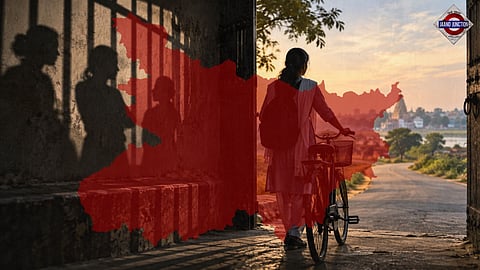

After Jamui, it is worth asking what Bihar really means by women’s empowerment when its women can have bicycles, ballots and panchayat seats, yet are still told to change their routes, clothes and curfews and made responsible for surviving men's behaviour while the culture of male entitlement remains largely untouched.
I have spent enough of my life outside Bihar to know that some things I once considered ordinary precautions were not ordinary at all.
The warnings were familiar: don't come home late, don't sit with boys, don't take the lonely road, don't tell people too much about yourself, don't attract attention, don't give anyone a reason to talk.
In Bihar, these things arrive so early in a girl's life that you stop hearing them as restrictions.
They become background noise.
You begin to mistake surveillance for care.
Then you live somewhere else for a while and discover something rather embarrassing - the world did not collapse because you walked home alone.
You could sit in a café with a man who was not your brother.
You could take public transport after sunset.
You could attend a class, go to a friend's house, return late and have nobody at home conduct an investigation into your character.
The strange thing was not that other places were perfectly safe.
They were not. Of course not.
What, even, is safe for a WOMAN?
The strange thing was that women elsewhere were not required to carry the entire burden of male behaviour on their backs.
I thought about this while watching the Jamui video.
On September 19, a Class 10 girl and a male classmate returning from coaching were stopped by a group of men in Jamui.
The two were surrounded, abused and assaulted; the girl was molested while the episode was recorded.
The footage later spread across social media.
Police registered a case under the POCSO Act, formed an SIT and arrested suspects.
By September 22, five accused had been arrested, according to police, and the alleged main accused, Nandan Yadav, was shot in the leg during an encounter before being arrested.
The police also registered cases against around 120 social-media account holders for circulating material that could reveal the minor's identity.
The legal reason for doing that is of course ‘understood.’
A minor's identity is protected, and circulating such material can itself be an offence.
But the sequence of events tells us something more about Bihar than any FIR can.
A girl was assaulted first.
The public discovered her assault later.
The state became highly visible after the video became highly visible.
That distinction here matters.
Because Bihar has a peculiar relationship with the suffering of its women: a woman's pain can remain private for years, but the moment it becomes a public embarrassment, everybody suddenly discovers the language of outrage.
This is why I do not want to write another article asking whether girls in Bihar are safe.
They are not.
The more interesting, rather overlooked and important question is: why does Bihar keep asking its girls to behave as though male violence is a natural feature of the landscape?
The answer is somewhere buried in something much older than ‘decent policing.’
Yes. It is buried in SHAME.
Bihar has spent generations teaching its women to carry shame that belongs to men.
A girl is told that the family will suffer if she is seen with the wrong boy. A woman is told that people will talk if she returns late. A mother worries about what the neighbours will say. A father worries about his daughter's reputation. A brother becomes the unofficial police officer of his sister's movements. And when a man actually behaves violently, the family frequently begins by asking what the woman was doing there.
As Simone de Beauvoir wrote, “the oppressor would not be so strong if he did not have accomplices among the oppressed themselves.”
That is patriarchy's oldest trick: men commit the violence and women are made responsible for preventing it.
A man behaves badly, and a woman is told to be more careful.
He crosses the line, and she is asked why she was standing there.
He takes away her freedom, and she is taught how to avoid provoking him.
The MAN behaves badly.
The WOMAN becomes responsible for preventing it.
That is why after every assault, the restrictions travel in the same direction.
Girls are told to stop going out. Parents become stricter. Coaching becomes a problem. Friends become a problem. Clothing becomes a problem. Phones become a problem. Evening becomes a problem.
Everything becomes a problem.
Nobody tells the boys of Bihar that perhaps they should not be allowed to roam around after dark because another boy might be assaulted.
Nobody says their mothers should check their WhatsApp chats.
Nobody asks what kind of character a seventeen-year-old boy has because he was seen with a girl.
Nobody proposes that sons need to earn back the freedom to use public roads.
The freedom is assumed to belong to them.
The caution is assigned to women.
This is how the system has always worked: men get the freedom, women get the precautions. That’s the architecture here.
And Bihar, my friends, has always been extraordinarily good at building architecture around women.
This is where, and this is WHY the state's celebrated history of women's empowerment deserves a more thorough reading.
Bihar gave women 50 per cent reservation in panchayati raj institutions in 2006. It became famous for the cycle scheme that encouraged girls to travel to school. Women entered local political institutions in unprecedented numbers. These are substantial interventions and they should not be dismissed.
But Bihar has been congratulating itself on these reforms for so long that it has stopped asking what happened after the girl got off the bicycle.
What happened when she reached home?
What happened when she chose her own partner?
What happened when she wanted to travel alone?
What happened when she refused a marriage?
What happened when she reported harassment by a relative?
What happened when she was assaulted by a man who knew that the family would prefer silence to scandal?
The bicycle was revolutionary.
The permission to ride it? It certainly, was not.
That is the distinction Bihar never really learned.
A woman can be physically moved through public space without becoming socially free in it.
You can put women into panchayats and still raise sons who think a woman walking alone has somehow made herself available for public commentary.
You can make a girl economically mobile and still make her socially accountable for the behaviour of men.
You can photograph women taking oath in elected offices while their daughters are being taught that their greatest political responsibility is to preserve family honour.
Bihar's feminism has often been strongest where the state can count it.
Fifty per cent reservation can be counted.
The number of bicycles distributed can be counted.
The number of women elected can be counted.
What cannot be counted so easily is whether a girl has stopped being afraid of the road outside her house.
So we keep counting the things that make Bihar look progressive and ignore the things that would force us to ask whether it actually is.
And this is where I get particularly tired of the permanent defence of Bihar.
Every time Bihar is criticised, someone produces another state.
Delhi is unsafe.
Uttar Pradesh is unsafe.
Rajasthan is unsafe.
Women are unsafe everywhere.
Yes.
So what?
A crime in Delhi does not absolve Jamui. A crime in Rajasthan does not make Bihar safer. The existence of patriarchy in Kerala does not cancel the existence of patriarchy in Bihar.
This obsession with comparison is one of the most childish forms of regional pride.
If your response to a fifteen-year-old being assaulted is to ask whether another state has a worse crime statistic, you are not defending Bihar. You are changing the subject.
And Bihar has become very good at changing the subject.
Talk about violence against women and somebody will talk about Bihar's poverty.
Talk about Bihar's poverty and somebody will talk about its ancient history.
Talk about its history and somebody will talk about its IAS officers.
Talk about women and somebody will bring up women sarpanches.
Talk about the failures of the police and somebody will tell you that crime exists everywhere.
Talk about a girl being assaulted and somebody will ask why she was outside.
There is always another subject.
The girl herself disappears, the victim is never the subject.
Justice is never the subject.
That is why Jamui is larger than Jamui.
The video is horrifying, but the most revealing thing about it may be the ordinary confidence of the men surrounding those teenagers.
They did not behave as though they had entered a forbidden space.
They behaved as though they had entered a space that belonged to them.
That confidence, dear readers, does not often appear overnight.
It is produced at home.
It is produced in schools.
It is produced in friendships.
It is produced when boys hear women being discussed as character types.
It is produced when a friend says something filthy about a girl and everyone laughs.
It is produced when a boy is forgiven for being “young” while the girl is punished for being seen.
It is produced when mothers tell daughters to be careful rather than telling sons to behave.
It is produced when fathers worry more about their daughter's reputation than the boy who damaged it.
It is produced when men remain silent because intervening would be inconvenient.
And it is produced by every decent man who thinks decency is a private quality rather than a responsibility to other men.
Men in Bihar have had the luxury of treating feminism as a women's hobby.
It is not.
It is a demand that men give up something they have been taught belongs to them automatically, i.e., the right to occupy public space without thinking about how their presence affects women.
That is why the safest thing Bihar can do for its daughters is not another scheme.
It is to make bad behaviour socially expensive for men.
Not through another lecture to girls. PLEASE. Enough of it already.
Not through another curfew.
Not through another family meeting about “what respectable girls do”.
Make the boy who harasses a girl unpopular among his friends.
Make the man who humiliates women embarrassing to know.
Make the uncle who makes filthy jokes at family gatherings someone nobody laughs with.
Make the friend who forwards an intimate video understand that his friends will not tolerate it.
Make the man who watches another man harass a woman feel ashamed of his silence.
That is how cultures change.
Not because the government announces a new programme, but because ordinary people stop giving ordinary misogyny a comfortable home.
Bihar knows how to produce shame.
It has been using it against women for centuries.
Perhaps it is time to redistribute it.
And perhaps that is the part of Bihar I find hardest to reconcile as a Bihari woman.
I have lived outside the state long enough to know that Bihar is not some uniquely cursed geography where women are doomed to suffer. I have lived in Bihar long enough to know that the problem cannot be dismissed as outsiders misunderstanding it either.
Bihar is capable of extraordinary affection, ambition, political intelligence and social change.
It is also capable of being brutally small-minded about women.
Both things are true.
The problem is that Biharis are often willing to defend the first truth so aggressively that they refuse to look at the second.
There is a peculiar pride in being Bihari that can become almost defensive when the subject turns to the state's failures. We love talking about our history, our civil servants, our students, our migrants, our political sophistication, our contribution to India. We are happy to tell everyone what Bihar has given the country.
Fine.
But what has Bihar given its daughters?
A bicycle, followed by a curfew?
A panchayat seat, followed by a lecture on family honour?
An education, followed by instructions about whom she may marry?
A job, provided she still comes home at the right hour?
A phone, provided someone else knows the password?
A vote, provided she does not use too much of her freedom?
This is why Bihar will continue to have shame attached to its name if it refuses to confront the particular ways in which it fails women.
Not because Bihar is uniquely wicked.
Not because every Bihari man is violent.
Not because every other state is enlightened.
Because Bihar keeps wanting credit for the freedom it has formally given women while refusing to examine the freedom it still socially takes away.
And there is another uncomfortable fact.
Some of Bihar's most ambitious daughters will leave.
They will leave for Delhi, Mumbai, Bengaluru, Hyderabad, Pune, London, New York, wherever work or education takes them.
They will build careers.
They will fall in love.
They will live alone.
They will make friends their parents have never met.
They will learn to take cabs at midnight, walk into restaurants alone, rent apartments, change jobs, travel without asking permission and make decisions without consulting the entire neighbourhood.
And Bihar will proudly call them its daughters.
It will put them on posters.
It will celebrate their success.
It will quote them in speeches.
But many of those daughters will subconsciously know that leaving was part of becoming free.
That should hurt.
A place should not have to lose its daughters in order to discover what they are capable of.
And if that sounds like I am being cruel to Bihar, perhaps Bihar has been allowed to confuse criticism with betrayal for too long.
I am not interested in protecting Bihar's reputation from the truth.
I am interested in asking why a fifteen-year-old girl should have to protect Bihar's reputation with her behaviour.
Because that is what we have always asked women to do.
Carry the family name.
Carry the caste name.
Carry the community's honour.
Carry the state's reputation.
Carry the consequences of men's choices.
Carry the shame.
And then, when they finally leave, carry our pride too.
I don't want to keep doing that.
Bihar's fate is not cursed because its daughters are difficult, modern, disobedient or ambitious. If anything, Bihar's daughters are the evidence that the state could be something much larger than the social restrictions it keeps imposing on them.
The tragedy is that many of those daughters have understood this before Bihar has.
For the record - this piece doesn't owe an apology to the other twenty-eight states and seven Union Territories, isn't offering character references for the rest of the planet, and it sure as hell isn't handing out participation trophies to "good men" for clearing the bar of not assaulting a child.
Views expressed in Citizen Junction stories are that of the author and solely of the author, submitted to Jaano Junction through WRITE. Start writing on Jaano Junction to get your opinion published. Click Here to start your citizen journalism journey.

