
2014 remains one of the most unforgettable years in Dutch cricket history. Under Peter Borren, the Netherlands men’s team scripted a miracle at the T20 World Cup, storming into the Super 10 after chasing 190 against Ireland in just 13.5 overs in Sylhet.
More than a decade later, Stephan Myburgh’s breathtaking 23-ball 63 still lives vividly in memory, not just as one of their best, but as one of the most astonishing run-chases the tournament has ever witnessed. In that very World Cup, the Dutch pulled off another remarkable victory, bowling England out for just 88 runs in a stunning display.
But while the men were making headlines and inspiring a generation, in the same year, the Dutch women’s team was simply trying to survive. They did not even have T20I status then and, instead of earning from the game, many players often dipped into their own pockets just to continue playing the sport they love. There was no full-time head coach either, a painful reminder of how little support surrounded women’s cricket in the country at the time.
It was amid that uncertainty that a 15-year-old Babette de Leede made her debut for the Netherlands in 2014, carrying little more than hope and a dream. 12 years later, that young girl now stands at the heart of a historic moment, preparing to lead the Netherlands into their maiden Women’s T20 World Cup under full-time coach Neil McRae. What once felt distant and fragile has finally turned into something beautifully real for Dutch women’s cricket.
“I made my debut earlier in 2014, but we didn’t have T20I status back then. We’ve come a long, long way since. Back then, we had to pay for our own tours and trips, and our coach wasn’t full-time. Gradually, things improved. Around 2019 or 2020, we got our first full-time head coach, who worked a lot with us and helped us get better,” Babette told IndiaToday in an exclusive interview.
“We also started receiving match fees or at least petrol money, so it didn’t cost us to play cricket or attend training. Now we’re at a stage where we earn match fees on tour, and some of the girls are on part-time contracts as well,” Babette said.
Cricket has always flowed through the veins of the De Leede family. Babette’s uncle, Tim de Leede, etched his name into Dutch cricket folklore during the World Cup 2003 when he produced a Player of the Match performance against India and even dismissed the great Sachin Tendulkar as his very first international wicket. Her cousin, Bas de Leede, has already carried the family legacy onto the ODI and T20 World Cup stages.
Now, another chapter is ready to be written. Babette is preparing to represent the Netherlands at one of cricket’s grandest events in England and Wales, adding her own story to a family that has long served Dutch cricket with pride.
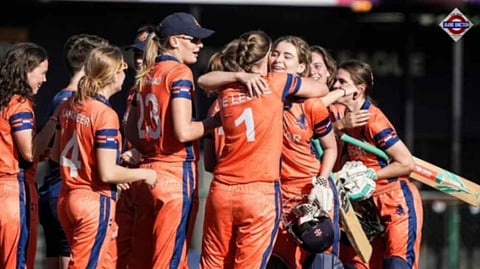
Earlier this year in Nepal, the Netherlands women scripted a remarkable run at the Qualifiers, winning five consecutive matches to book their place at the global event alongside Bangladesh. In 2018, the Netherlands gained T20I status, a milestone that became a launchpad for the team’s rise on the international stage.
“Oh, it’s just huge. The moment still gives me shivers. It was amazing because we had set this goal 23 years ago as a team, and to finally achieve it, winning our first five games and qualifying for the World Cup alongside Bangladesh was incredible,” Babette said.
“We worked really, really hard for it. There were a lot of tears and a lot of joy. For women’s cricket in the Netherlands, this is massive. I really hope we’ve inspired a lot of young girls, and that we can continue to do so at the World Cup,” Babette added.
Babette has witnessed every phase of Dutch women’s cricket: from an era where players battled limited resources and often contributed from their own pockets just to continue playing, to now standing on the doorstep of a World Cup. Hence, the moment must have felt surreal for her as they secured their place in the multi-national tournament.
Qualifying for the World Cup was a landmark achievement, but the challenge ahead is even steeper for the Netherlands. Drawn alongside powerhouses like India, Australia and South Africa, the Dutch know there will be little room for error against some of the strongest sides in world cricket.
Yet, Babette has no intention of being content with merely making up the numbers. For her, qualification was never meant to be the finish line. Reaching the semi-finals would likely require the Netherlands to upset the big teams in world cricket, but Babette believes this Dutch side is capable of springing a few surprises.
More importantly, she sees this World Cup as part of a much bigger journey. Beyond chasing results in the present, Babette also spoke about building consistency and ensuring the Netherlands qualify for the next edition of the Women’s T20 World Cup.
“Yeah, we want to finish in the top eight so that we don’t have to go through qualification for the next World Cup again. Realistically, that means winning a couple of games, which I believe we’re capable of. It’s a really good challenge for us, and I’m very excited to see how we go about it,” Babette said.
“I think it’s going to be an amazing opportunity for us to measure ourselves against the best in the world. We’ve never really had the chance to play these teams before, so it will be great to see where we stand. We definitely want to compete, we’re not going there just for the experience. We’ve trained really hard and continue to do so. We’ll be aiming to put in strong performances and hopefully cause a few upsets,” Babette added.
While Babette has been a familiar face in the Netherlands set-up for more than a decade, captaincy is still a relatively new chapter in her career. She took over as Dutch skipper in October 2024 after Heather Siegers stepped down to focus on recovering from injury. Under Siegers, the Netherlands had shown steady growth, and Babette was viewed as the natural successor to lead the side into a new era.
The transition, however, was not without its challenges. Babette admitted captaincy initially felt overwhelming as she tried to balance her own performances with tactical duties. Over time, though, she settled into the role and began embracing the added responsibility. What once felt demanding has now become something she genuinely enjoys.
“Oh, it’s been amazing. I’ve really, really enjoyed it. At first, it was a bit overwhelming. I obviously had to focus on my own game while also managing field placements, bowling changes and everything that comes with captaincy. So, there was a lot to learn, even technically,” Babette said.
“Growing up, I watched and played a lot of cricket, so I had a fair idea, but not the actual experience of leading a team. That’s something I’ve really grown into, and I’ve enjoyed the process.
“Captaincy just adds something extra to the game. Cricket itself is already complex and a lot of fun, but leading the side makes it even more engaging. I love everything that comes with it,” Babette added.
Babette has enjoyed a promising start to life as Netherlands captain. Leading the side in 40 T20Is so far, she has guided the Dutch to 29 victories, underlining the impact she has already made as skipper. Beyond her leadership, Babette has continued to contribute heavily with the bat as well and now stands just 67 runs short of the 1000-run mark as captain in T20Is.
Behind the stumps too, she has remained sharp and dependable, making her one of the most complete players in the Dutch set-up. With her all-round ability to influence matches, expectations will naturally be high when she leads the Netherlands onto the field at the T20 World Cup.
With the T20 World Cup on the horizon, a quiet shift is underway in Dutch cricket, and 2026 could well mark its turning point. For the Netherlands women’s team, this is more than just another season, it signals the beginning of a new dawn. In less than a month, the Lionesses will walk out to face Bangladesh in their debut T20 World Cup match, carrying with them years of steady, often understated progress.
At the centre of this rise stands Babette de Leede, who now has the opportunity to take the Netherlands where her predecessors could not. Pioneers like Helmien Rambaldo, Juliet Post and Heather Siegers laid the foundation as far back as 2008, when the Dutch played their first T20. Babette has built on that platform, guiding the side to a stage that once felt distant.
For the Netherlands, a dream nurtured for over two decades is finally becoming reality. They may not enter the tournament as favourites, but this is a chance for Babette and her side to show they belong at the highest level. More than just participating, the Dutch will want to prove they can stand shoulder to shoulder with the world’s best and signal that they are here for the long haul.
