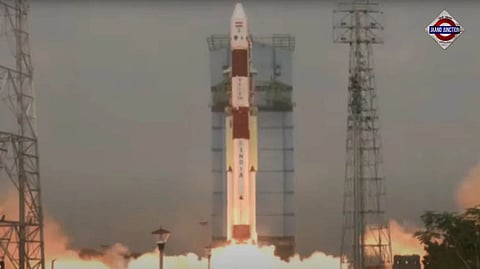

India's trusted workhorse rocket, the Polar Satellite Launch Vehicle (PSLV), successfully staged a strong comeback today, putting behind it last year's setback.
The 64th mission of PSLV, PSLV-C62 / EOS-N1, lifted off from the Satish Dhawan Space Centre in Sriharikota at 10:18 am.
ISRO Chairman Dr V Narayanan on Monday said a deviation was observed in the third stage of the PSLV mission and that the data is being analysed. He added that the space agency would share details at the earliest. Dr Narayanan, however, stopped short of declaring the mission either a success or a failure.
The flight carried a total of 15 satellites, including a highly classified surveillance satellite named Anvesha, developed by the Defence Research and Development Organisation (DRDO).
PSLV-C62 carried EOS-N1 and 15 co-passenger satellites. EOS-N1 and 14 co-passengers are planned for injection into Sun Synchronous Orbit while the Kestrel Initial Demonstrator (KID) is planned for a re-entry trajectory.
The Anvesha satellite is designed to provide cutting-edge imaging capabilities, enabling India to map enemy positions with pinpoint accuracy.
Beyond the strategic payload, this mission is historic for another reason: India's private space sector is stepping into the limelight. For the first time, a single Indian private company, Dhruva Space, based in Hyderabad, is contributing seven satellites to the mission.
The last PSLV mission in May 2025 ended in failure due to an anomaly in the rocket's third stage. This launch is not just about deploying satellites but about restoring confidence in India's most reliable launch vehicle and reinforcing ISRO's reputation as a global player.
Moreover, the mission signals a paradigm shift. For decades, India's space programme was synonymous with ISRO. Today, private players like Dhruva Space are emerging as critical partners, offering end-to-end solutions from satellite design to deployment and even ground station services.
