
Most of India was still asleep when four astronauts splashed down in the Pacific Ocean at 5:37 am IST on April 11, 2026.
But what had just happened was very much worth waking up for.
The Orion spacecraft, a capsule the crew had named Integrity, had carried them farther from Earth than any human being in history.
And that was just one of the eight records they broke.
Artemis II was a 10-day lunar flyby mission that launched on April 2, 2026.
It was the first crewed flight of Nasa's Artemis programme and the first time humans had gone beyond low Earth orbit since Apollo 17 in 1972.
Low Earth orbit is the region of space that sits roughly up to 2,000 kilometres above our planet's surface.
It is where the International Space Station lives and where most astronauts have spent their time. Venturing beyond it means entering the vast, hostile stretch of deep space, where distances are enormous and Earth’s gravitational hold begins to loosen.
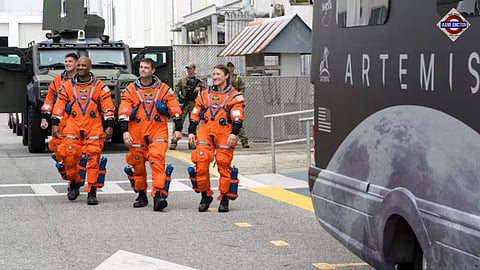
The crew included Nasa Commander Reid Wiseman, Pilot Victor Glover, Mission Specialist Christina Koch, and Canadian Space Agency astronaut Jeremy Hansen.
Together, they did not just fly around the Moon. They rewrote the record books eight times over.
The Orion spacecraft reached its maximum distance from Earth at 4,06,771 kilometres, setting a new record for human spaceflight. To truly feel the weight of that number, you need a bit of history.
Apollo 13 was a 1970 Moon mission that went catastrophically wrong mid-flight.
An oxygen tank exploded onboard, and the crew had to abandon their original plan and use a free-return trajectory to get home.
A free-return trajectory is nature's emergency exit from space: the spacecraft uses the Moon's gravity to slingshot itself back toward Earth without needing to fire its engines much.
Think of it like rolling a marble around the inside of a bowl and letting it come back on its own. That unplanned loop pushed the Apollo 13 crew farther from Earth than anyone before or since. That record stood unbroken for 56 years.
On April 6, 2026, six days into the Artemis II mission, the crew surpassed that record for the farthest distance humans have ever travelled from Earth.
From aboard the spacecraft, Canadian astronaut Jeremy Hansen said: "We surpass the furthest distance humans have ever travelled from planet Earth. We most importantly choose this moment to challenge this generation and the next to make sure this record is not long-lived."
On the Artemis II mission, Christina Koch became the first woman to travel beyond low Earth orbit and journey around the Moon.
Every human being who had gone that far before her, all 24 men from the Apollo era, was a white American male.
Koch changed that. She is no stranger to breaking barriers either. Koch previously set the record for the longest single spaceflight by a woman, spending 328 consecutive days in space, and she participated in the first all-female spacewalk.
A spacewalk is when an astronaut leaves the spacecraft and moves around in space in a protective suit, usually to repair or upgrade equipment on the outside of a spacecraft.
With Artemis II, Koch added another milestone to a career already full of them.
Nasa astronaut Victor Glover made history on April 2 as the first Black astronaut to travel toward the Moon, on a ten-day mission that marked the first human departure from Earth orbit in more than 50 years.
Glover, a decorated US Navy captain and test pilot, had previously become the first Black astronaut to serve on a long-duration mission aboard the International Space Station.
Before joining Nasa, he flew more than 40 aircraft during a US Navy career that included combat deployments and test-pilot duties.
Despite the enormous weight of this milestone, Glover has said he hopes such firsts will one day be unnecessary, a sign that space truly and fully belongs to everyone.
At age 50, Commander Reid Wiseman became the oldest human to travel beyond low Earth orbit and the first person to command a lunar mission since Gene Cernan on Apollo 17.
Wiseman was also at the centre of the mission's most emotional moment.
During the lunar flyby, the crew spotted two small, unnamed craters on the Moon's surface and asked Mission Control if they could name them.
One was named Integrity, after their spacecraft. The other they named Carroll, after Wiseman's late wife, who died of cancer in 2020. Mission Control said yes, and there were tears aboard Integrity that day.
Canadian Space Agency astronaut Jeremy Hansen became the first non-American to travel beyond low Earth orbit and the first to journey to the vicinity of the Moon. The entire Apollo era had been exclusively American.
Every single person who had ever gone that far from Earth held a US passport. Artemis II finally opened that door to the rest of the world.
Artemis II also quietly set one more record: it sent four people into deep space simultaneously, one more than any Apollo mission ever did.
Deep space is the region of space that lies beyond the Earth-Moon system.
Every single crewed Apollo lunar mission, from Apollo 8 in 1968 to Apollo 17 in 1972, carried exactly three astronauts beyond low Earth orbit.
Artemis II was the first mission in history to take four.
Yes, and it was extraordinary.
As the Orion spacecraft swung around the far side of the Moon on April 7, the crew entered a communications blackout lasting around 40 minutes, one of the longest in human spaceflight history.
A communications blackout is when the Moon physically blocks all radio signals between the spacecraft and Mission Control on Earth, leaving the astronauts completely cut off and on their own.
During Apollo missions, these blackouts were shorter.
Artemis II, flying a different and longer path around the Moon, experienced one of the most prolonged silences ever recorded between humans in space and Earth.
While cut off from Earth, the crew witnessed something no human had seen in over 50 years: the Moon's far side, the hemisphere that permanently faces away from Earth, illuminated and close enough to photograph in detail.
And then came something even more astonishing.
As Orion, the Moon and the Sun aligned perfectly, the crew experienced a total solar eclipse from space, lasting nearly an hour.
On Earth, a total solar eclipse, when the Moon completely blocks the Sun, lasts only a few minutes at most.
From where the Artemis II crew sat, it lasted almost 60 minutes.
They watched the Sun's outer atmosphere, the solar corona, glow around the edges of the Moon, and spotted planets including Venus, Mars and Saturn in the surrounding darkness.
Victor Glover, lost for words, simply said: "Humans probably have not evolved to see what we are seeing. It is truly hard to describe."
Mission managers acknowledged that this was a test flight, and several elements, including the heat shield, a valve in the service module, and the toilet, will need further inspection and redesign.
The heat shield is the protective layer on the underside of the capsule that absorbs the tremendous heat generated when the spacecraft slams back into Earth’s atmosphere at high speed.
During Artemis II's return, the outside of the capsule reached temperatures of around 2,700 degrees Celsius, hotter than lava, and the heat shield bore the full brunt of that.
Under the revamped Artemis programme, Artemis IV is expected to be the first crewed lunar landing since Apollo 17, with Nasa targeting early 2028 for the mission near the Moon's South Pole.
For now, though, four astronauts are home, and eight records that had stood for over half a century are no longer standing.
