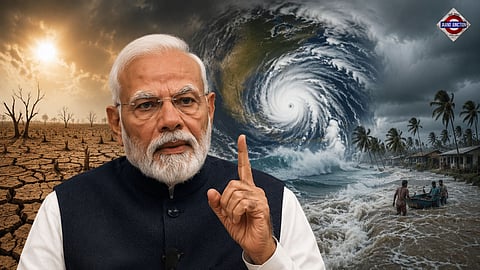

Prime Minister Narendra Modi flagged the risks posed by emerging El Nino conditions and urged states to strengthen water conservation efforts, while calling for a coordinated national response to climate-related challenges during the 11th Governing Council Meeting of NITI Aayog.
Chairing the day-long meeting attended by all 28 states and five Union Territories, Modi emphasised that climate variability could pose significant challenges to agriculture, water resources and livelihoods, making preparedness and sustainable resource management essential.
According to an official statement, the Prime Minister specifically warned about the potential impact of El Nino conditions and stressed the need for states to focus on water conservation measures.
El Nino is a periodic warming of waters in the central and eastern Pacific Ocean, and is generally associated with weaker monsoon rains over India.
The World Meteorological Organisation (WMO) has already warned that an El Nino event is expected to develop from mid-2026 and influence weather patterns worldwide.
His remarks come at a time when weather experts around the world are closely monitoring the development of El Nino, a climate phenomenon associated with warmer-than-normal sea surface temperatures in the equatorial Pacific Ocean that can influence rainfall patterns across several regions, including India.
According to Japan's meteorological authorities, sea surface temperatures across the equatorial Pacific have remained warmer than average, signalling the onset of El Nino conditions that are expected to continue through the Northern Hemisphere's autumn season.
For India, El Nino is often associated with weaker monsoon rainfall, prolonged heatwaves and an increased risk of drought. The phenomenon can disrupt the southwest monsoon by reducing the strength of moisture-laden winds that normally bring widespread rains to the country.
The Prime Minister's caution on climate risks formed part of a broader agenda focused on building a developed India, or "Viksit Bharat," through cooperative federalism and long-term planning.
Modi noted that despite economic uncertainty affecting many major economies, India's growth story continues to inspire the world. He urged states to strengthen the country's journey towards self-reliance by adopting global best practices, particularly in renewable energy and emerging technologies.
The Prime Minister also highlighted the transformative potential of artificial intelligence, describing AI as an opportunity rather than a threat.
However, he called for safeguards against emerging social challenges, including cyber fraud and drug abuse. He urged states to invest in skill development so that India's youth can benefit from the opportunities created by new technologies.
