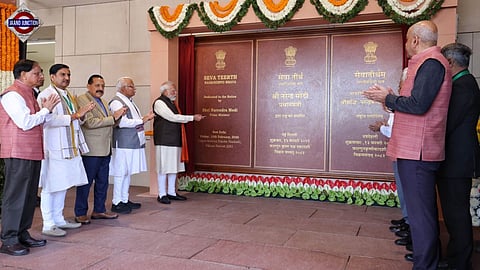

Prime Minister Narendra Modi on Friday said that India is stepping into a new phase with the resolve of building a “Viksit Bharat” as he dedicated the newly built ‘Seva Teerth’ to the people of the country.
India’s most powerful address changed today as Prime Minister Narendra Modi inaugurated Seva Teerth, the new integrated complex that will house the Prime Minister’s Office (PMO). The relocation -- a first since Independence -- marks a shift to a modern, state-of-the-art facility designed to consolidate key executive functions and enhance administrative efficiency.
In his address, PM Modi congratulated the Prime Minister’s Office team and all secretariats for their role in the transition. He said that the North Block and South Block were constructed by the British and stood taller than other buildings, reflecting the architecture and administrative priorities of that era.
“Now it is not like that,” PM said, underlining the symbolic shift represented by the new complex.
The Prime Minister described Seva Teerth as a space from where policies will be framed and stressed that such a place must be effective and inspiring. He added that the old buildings faced space constraints, which made functioning difficult.
To mark the moment, which the government has described as a "transformative milestone in India’s administrative governance architecture," the Prime Minister also released a Rs 100 commemorative coin.
PM Modi unveiled the name 'Seva Teerth' at around 2 pm before formally inaugurating Seva Teerth and Kartavya Bhavan 1 and 2, which will accommodate several key ministries. The project reflects the Prime Minister’s vision of building a modern, efficient and citizen-centric governance ecosystem, officials said.
Recalling the historical context, the Prime Minister said that when the buildings on Raisina Hills were inaugurated, the then Viceroy had stated that they were built in accordance with the wishes of the British Emperor. He said this meant that those structures were intended to realise the British Emperor’s vision on the land of enslaved India. He added that Raisina Hills was chosen so that the buildings would stand above the others.
PM described Seva Teerth as a space from where policies will be framed and stressed that such a place must be effective and inspiring. PM said the old buildings faced space constraints, which affected functioning.
“With the resolve of a developed India, we are entering Seva Teerth,” PM said, as he dedicated the complex to the citizens of the country.
In his first set of decisions after moving to Seva Teerth, PM Narendra Modi approved key initiatives benefiting farmers, women, youth and vulnerable citizens. They include:
PM Rahat scheme: Provides cashless treatment up to Rs 1.5 lakh for accident victims.
Lakhpati didis target doubled: Goal was raised to 6 crore by March 2029, after crossing 3 crore ahead of schedule.
Agriculture infrastructure fund: Outlay doubled from Rs 1 lakh crore to Rs 2 lakh crore to strengthen the farm value chain.
Startup India fund of funds 2.0: Rs 10,000 crore corpus to boost deep tech, early-stage ventures and advanced manufacturing.
For decades, ministries operated from ageing, scattered buildings across the Central Vista, leading to coordination gaps, logistical hurdles and high maintenance costs. The new complexes aim to resolve these issues by bringing key administrative arms together in future-ready infrastructure designed for seamless coordination.
The government expects the consolidation to speed up decision-making, reduce costs and enhance transparency.
Seva Teerth will house three core executive institutions -- the Prime Minister’s Office (Seva Teerth-1), the National Security Council Secretariat (Seva Teerth-2) and the Cabinet Secretariat (Seva Teerth-3) -- which earlier functioned from separate locations. Their co-location is expected to strengthen strategic coordination at the highest levels of government.
Kartavya Bhavan-1 and 2 will accommodate key ministries including Finance, Defence, Health and Family Welfare, Corporate Affairs, Education, Culture, Law and Justice, Information and Broadcasting, Agriculture and Farmers Welfare, Chemicals and Fertilisers, and Tribal Affairs. The consolidation is aimed at improving inter-ministerial coordination and easing public access.

The new complexes feature digitally integrated offices, structured public interface zones and centralised reception facilities to improve efficiency and citizen engagement. Advanced digital infrastructure is expected to support e-governance and transparent administration.
Built to 4-Star GRIHA standards, the complexes incorporate renewable energy systems, water conservation measures, waste management solutions and energy-efficient building design. According to the PMO, these measures reduce environmental impact while improving operational performance.
The facilities are equipped with smart access controls, integrated surveillance and advanced emergency response systems to ensure security without compromising accessibility.
With this relocation, the government aims to set a new benchmark in administrative infrastructure -- consolidating key institutions into a modern, integrated complex designed to support faster, coordinated and citizen-focused governance.
Once vacated, the South and North Blocks, where the Prime Minister's Office has been running, will be converted into a public museum, 'Yuge Yugeen Bharat Sangrahalaya'.
An agreement was signed on December 19, 2024 with France’s Museum Development Agency for the technical cooperation for the development of the planned museum.
