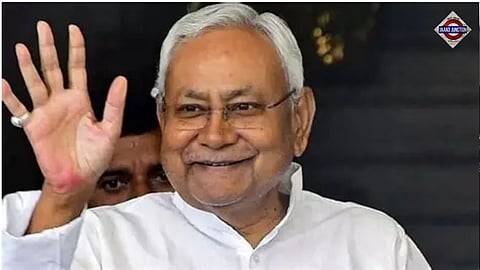

Bihar Chief Minister Nitish Kumar resigned from his post on Tuesday, April 14, after chairing a crucial Cabinet meeting.
The meeting is said to have discussed several key agenda items and could be the final one convened by the current Council of Ministers.
Nitish’s move has set the stage for a leadership transition in the state.
The announcement of the new Bihar Chief Minister is likely to take place today, signalling a significant political shift within the ruling National Democratic Alliance (NDA).
Days before, Nitish Kumar took oath as a Rajya Sabha Member of Parliament on April 10, a development widely seen as paving the way for a restructuring of leadership in the state government.
JD(U) SAYS NITISH WILL CONTINUE TO GUIDE BIHAR’S DEVELOPMENT
Janata Dal (United) Working President and Rajya Sabha MP Sanjay Kumar Jha asserted that Nitish Kumar remains committed to Bihar’s progress, irrespective of whether he continues as Chief Minister.
“As far as Bihar is concerned, we contested the 2025-30 election mandate under Nitish Kumar’s leadership with the support of the NDA. The Prime Minister campaigned regularly, and the new government will continue Nitish Ji’s policies and work under his guidance. Even if he is not Chief Minister, his focus remains on Bihar, travelling to Delhi only for Parliament sessions," Jha said.
According to ANI, JD(U) leaders maintain that Kumar’s governance framework and policy direction will continue to influence the next government, underlining continuity even amid leadership changes.
GROWING SPECULATION OVER SUCCESSOR
With an increase in political activity around the question of Bihar’s next Chief Minister, Deputy Chief Minister Samrat Chaudhary, on April 12, visited Nitish Kumar’s residence in Patna, even as speculation intensified over the leadership transition.
While no formal announcement has been made, it is widely speculated that the next Chief Minister may come from the Bharatiya Janata Party (BJP), indicating a potential recalibration of power-sharing within the NDA alliance.
The report also pointed to differences within the JD(U), with sections of party workers expressing dissatisfaction over Kumar’s move to the Rajya Sabha.
Posters were put up in Patna by party workers calling for Nishant Kumar, Nitish Kumar’s son, to take on a larger political role.
MOVE TO RAJYA SABHA COMPLETES UNIQUE LEGISLATIVE JOURNEY
Nitish Kumar’s election to the Rajya Sabha marked the fulfilment of his long-stated ambition to serve in every legislative house in India, including the Bihar Assembly, the Bihar Legislative Council, the Lok Sabha, and now the Rajya Sabha.
Following his election to Parliament, Kumar resigned from his membership of the Bihar Legislative Council.
MLC Sanjay Gandhi submitted his resignation to Council Chairman Awadhesh Narayan Singh.
His political management of alliance dynamics has played a crucial role in ensuring the NDA’s continued hold over power in Bihar.
The expected leadership change is being viewed as a structural transition within the alliance, with implications for governance and political strategy ahead of future elections.
The resignation of Nitish Kumar marks a pivotal moment in Bihar politics, with the NDA preparing for a leadership change while maintaining policy continuity.
Party leaders have indicated that Kumar will continue to play a guiding role in shaping governance priorities even after stepping down as Chief Minister.
