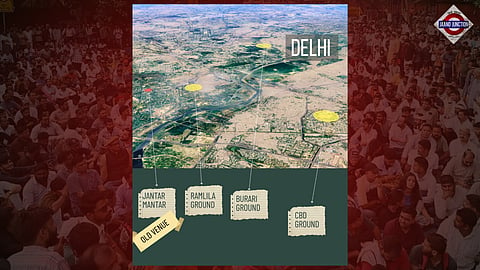

Delhi's Jantar Mantar, one of the capital's most recognisable locations for political demonstrations and public campaigns, is no longer a designated protest site. Delhi Police has instead named three alternative venues for protests and sit-ins: Ramlila Ground, Burari Ground and CBD Ground in East Delhi.
The decision was announced on Monday, October 12, through an order issued by Delhi Police Commissioner Anurag Kumar. The order follows recommendations made by a committee constituted by the Union Ministry of Home Affairs to examine alternative locations where citizens could organise demonstrations.
The new arrangement marks a significant change in Delhi's protest framework. Jantar Mantar has served for years as a recognised venue where political parties, civil society groups, activists and citizens have gathered to raise public issues and demand government action.
The Delhi Police order identifies three grounds where demonstrations and sit-ins can now be organised under the revised arrangement.
Located in central Delhi, Ramlila Ground is a familiar venue for large political rallies, public meetings and demonstrations. It is the closest of the three alternatives to the central areas where many national political institutions and government offices are located.
Situated in north Delhi, Burari Ground offers a large open space away from the congested central district. It has previously been associated with large gatherings and provides another location for demonstrations in the northern part of the capital.
CBD Ground in East Delhi completes the new list, providing a designated venue on the eastern side of the city. Its inclusion means the three alternatives are spread across different parts of Delhi rather than concentrated around Jantar Mantar.
Delhi Police has said that a detailed, revised standard operating procedure (SOP) governing protests at the three locations will be issued separately. Organisers will need to follow the applicable permission process and venue-specific conditions.

According to the police order, the decision follows the recommendations of a committee established by the Union Home Ministry to examine alternative venues for protests and demonstrations.
The change comes amid heightened security preparations in central Delhi following demonstrations organised by political groups and the Cockroach Janta Party (CJP). Recent protests have centred on demands for the resignation of Chief Election Commissioner Gyanesh Kumar and objections to revisions of electoral rolls. The controversy has also prompted restrictions on movement, heavy police deployment and disputes over permission to hold demonstrations.
The police have cited public safety, traffic management and law-and-order concerns in the context of recent protest permissions and security arrangements. However, the order announcing the new sites does not itself establish that these concerns were the sole reason for removing Jantar Mantar from the designated list.
The immediate administrative effect is clear: Jantar Mantar is no longer one of Delhi's officially designated venues for protests under the revised arrangement.
For protest organisers, the change means that Jantar Mantar can no longer be treated as the designated venue under the earlier framework. Organisers will need to consider the newly notified locations and comply with the applicable permission requirements.
The revised SOP will be important in determining how demonstrations are organised at the new sites, including the procedures for seeking permission and any conditions imposed on gatherings.
The development also raises questions about accessibility. Jantar Mantar's location in central Delhi has made it a prominent venue for groups seeking to draw public and political attention to their demands. Moving designated demonstrations to other parts of the city could change how easily protesters reach their chosen venue and how visible their campaigns are.
At the same time, the three newly designated grounds provide alternatives for public gatherings. The practical effect will depend on how the revised arrangements are implemented and how permission requests are handled.
Jantar Mantar is best known for its historic astronomical observatory, but the surrounding area has also become synonymous with public demonstrations in Delhi.
Over the years, the site has hosted protests on issues ranging from corruption and electoral reforms to women's safety, employment, farmers' concerns and government policy. Its central location and long association with public mobilisation have made it a familiar destination for activists, political groups and citizens seeking to make their voices heard.
Its removal from the designated list therefore represents more than a change in venue. It alters an established part of the capital's arrangements for organised public dissent.
The decision also brings renewed attention to the balance between managing crowds and traffic in a densely populated capital and ensuring that citizens can exercise their right to peaceful assembly.
The next step is the issuance of the revised SOP for Ramlila Ground, Burari Ground and CBD Ground. Until the detailed procedures are published, protest organisers should consult official Delhi Police instructions before planning demonstrations.
The police order changes the designated locations; it does not, by itself, resolve the wider debate over how protests should be regulated or how easily citizens can access public spaces to express their demands.
For now, Jantar Mantar is no longer a designated protest site, and Delhi Police has named three alternatives: Ramlila Ground, Burari Ground and CBD Ground in East Delhi.
