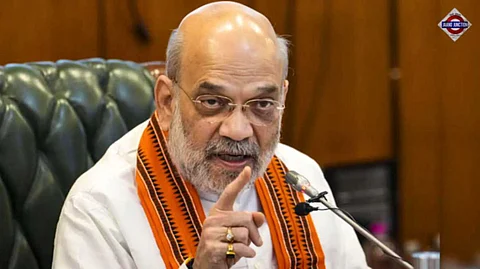

Home Minister Amit Shah on Monday said Naxalism is in its “last breath” and has nearly been wiped out from Chhattisgarh’s Bastar, the hotbed of Maoist violence, under the Narendra Modi-led government. His remarks came ahead of the March 31 deadline set by the Centre to eradicate Naxalism.
Detailing the government’s push in the Lok Sabha, Amit Shah said Bastar is now on the “path of development”, while crediting security forces, state police and local tribal communities for the turnaround.
Amit Shah said more than 4,800 Naxals laid down their arms and took part in the government's rehabilitation programme. He said there were only two Naxal-affected districts in the country. He also added that 706 Naxals alone were gunned down in the past three years, highlighting the government's aggressive approach towards ending Maoist violence.
Targeting the Congress, Amit Shah accused the party of failing to deliver welfare benefits to tribals in Naxal-affected regions during its tenure. He also rejected the argument that underdevelopment fuelled the insurgency, asserting instead that Naxalism was driven by ideology.
“The root cause of Naxalism is not the demand for development. It is an ideology that Indira Gandhi embraced in 1970 to win the presidential election. Naxalism spread because of this Leftist ideology,” he said.
He accused the Opposition of sympathising with Naxal elements. “Those who speak for Naxals should look within. Why could they not end it from 1970 till now?” he asked.
Placing the issue in historical context, Shah said tribal communities, once inspired by leaders like Birsa Munda, Tilka Manjhi and Rani Durgavati, were drawn towards Maoist ideology due to governance gaps. “The previous governments never truly reached them,” he said, alleging that a “false narrative” was propagated among tribals.
Amit Shah said Maoist violence has claimed nearly 20,000 young lives and impacted around 120 million people, calling it a failure of Congress rule that tribals and other communities remained deprived of development.
Highlighting the scale of the insurgency at its peak, Amit Shah said 12 states, including Chhattisgarh, Jharkhand, Odisha and Maharashtra, were once part of the Red Corridor, where “the rule of law had ended”. “Crores of people lived in poverty and thousands of young lives were lost,” he said.
“Over 75 years, the Congress governed for 60 years. Why did tribal communities remain deprived? Former Prime Minister Manmohan Singh had once said Naxalism posed a bigger threat than terrorism in Kashmir and insurgency in the Northeast. Despite this, nothing was done,” he said.
Highlighting initiatives taken since the Modi government came to power in 2014, Amit Shah said several long-pending issues have been resolved. “Article 370 and 35A were removed, the Ram Temple has been built, GST and CAA have been implemented and 33 per cent reservation for women was ensured. Many aspirations since Independence have been fulfilled in the past 12 years,” he said.
The Home Minister reiterated that the country is close to becoming Naxal-free. “Naxalism has been virtually eradicated from Bastar,” he said, adding that welfare schemes have now reached remote villages.
“A campaign has been launched in every village. Schools are being built, ration shops opened, hospitals established. People now have Aadhaar and ration cards, receive food grains, and LPG cylinders are being distributed,” he said.
At the same time, Amit Shah struck a firm note on security. “This is the government of Narendra Modi. Whoever takes up arms will be dealt with firmly,” he said, stressing that violence has no place in a democracy. “You cannot reject the Constitution and pick up weapons. This will not be tolerated.”
He added that while the government is open to dialogue and addressing grievances, it will not allow armed movements to dictate terms or obstruct governance.
Amit Shah also noted that 92 per cent of weapons used by Naxalites were looted from police forces, underscoring the intensity of the insurgency.
He paid tribute to security personnel and civilians who lost their lives in the decades-long conflict, crediting CAPF forces, state police and tribal communities for bringing Naxalism to the brink of elimination.

