
Who was behind the February 28 strike on Shajareh Tayyebeh girls’ elementary school in Minab, Hormozgan province, southern Iran?
Was it the United States (US) or Israel or as US President Donald Trump put it, “Iran’s mistake"? Fact-checks seem to have answered the question.
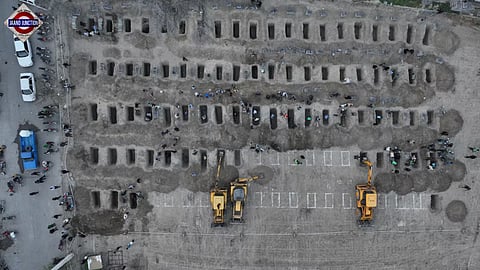
On February 28, a massive strike on the Shajareh Tayyebeh girls’ elementary school in Minab, Hormozgan province, southern Iran, killed between 165 and 180 people, most of whom were schoolgirls aged 7 to 12. The incident occurred during the opening hours of a broader US-Israeli military campaign against Iran.
The Shajareh Tayyebeh school was located adjacent to the Sayyid al-Shuhada military complex, an IRGC Navy base.
Investigations suggest a “double-tap" strike occurred, where a second missile hit while students and staff were seeking shelter in a prayer hall after an initial explosion.
Analysis by Al Jazeera indicated the school had been a clearly defined civilian institution for over 10 years, suggesting either a grave intelligence failure or a deliberate attack.
Investigations by Dutch fact-checking group Bellingcat, the New York Times, and The Washington Post have linked the February 28, 2026, strike on a girls’ elementary school in Minab, southern Iran, to a U.S. Tomahawk cruise missile.
Visual analysis of footage released by Iran’s Mehr News Agency identified the weapon as a BGM-109 Tomahawk Land Attack Missile (TLAM). Experts noted that the United States is the only participant in the current conflict known to possess this specific long-range precision weapon.
Trevor Ball shared on X what he alleged was previously unseen footage – from Iran’s Mehr News – of the missile striking a building in the compound linked to the elite Revolutionary Guard Corps. He said it showed “for the first time, that the United States (had) struck the area".
“The US is the only participant in the war that is known to have Tomahawk missiles. Israel is not known to have Tomahawk missiles," he wrote.
The video released by Mehr News also showed comparisons between the missile that struck the IRGC compound and a closer view of another Tomahawk.
Bell said the video had been geolocated, i.e., the precise location had been confirmed using digital information, and that it directly contradicted Trump’s claim.

In his thread, Bell also shared satellite imagery of the IRGC compound and a graphic of the missile’s larger area of impact. “… imagery shows only two structures within this red cone were damaged, including a clinic. The other structure appears to be an earth-covered bunker."
Israel has denied conducting the strike, though on Saturday Tel Aviv was blamed by Trump. “We think it was done by Iran. Because they are very inaccurate, as you know, with their munitions. They have no accuracy whatsoever," the US President told reporters aboard Air Force One.
Multiple analysis, including one by the Associated Press, suggests it was an American strike. The biggest tell, AP argued, was that the US military had launched an ‘assessment".
Pentagon protocol states an ‘assessment’ is launched in case of initial determination the US military may have caused harm to civilians. Also, a government official who asked not to be named told AP the strike was “likely (by the) US". When asked, CENTCOM chief Captain Tim Hawkins said, “It would be inappropriate to comment given incident is under investigation."
The school is adjacent to a walled compound labeled on maps as the Seyyed Al-Shohada Cultural Complex of the Guard, which included a pharmacy, gym and sports field.
Targeting schools is a clear violation of international laws governing armed conflict, said Elise Baker, a senior staff lawyer at the Atlantic Council, a Washington-based nonprofit think tank.
United States President Donald Trump initially suggested Iran and then Israel was responsible due to “inaccurate" munitions. However, U.S. Central Command (CENTCOM) acknowledged it was investigating the incident, and unnamed officials later admitted to Reuters that U.S. forces were likely responsible.
At a Pentagon press briefing Wednesday, US Defense Secretary Pete Hegseth said, “All I can say is that we’re investigating that. We, of course, never target civilian targets. But we’re taking a look and investigating that."
UN experts and UNESCO described the strike as a “grave violation of humanitarian law" and a potential war crime, calling for an independent investigation.
The Iranian government condemned the strike as a “blatant crime" and a violation of international law.
