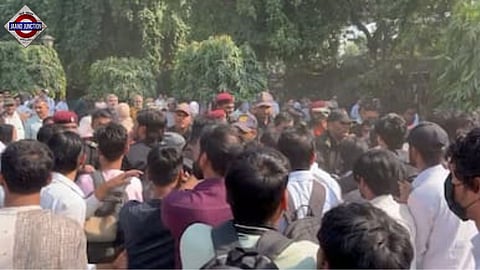

The standoff at Jamia Millia Islamia took a fresh turn on Sunday after students were reportedly detained at Gate No. 7, even as the university remained tense over an ongoing agitation demanding the return of the students’ union
A photograph circulated from the campus showed students being detained at the gate. The development came a day after the university moved all classes online and announced restrictions on access to several facilities, including the library and canteens
The measures have added to growing anger among protesters, who have been holding demonstrations and a hunger strike since October 12. The students say they want the Jamia Millia Islamia Students’ Union (JMISU) restored and the university’s Chief Proctor removed.
The administration, meanwhile, has been trying to bring the protest to an end after several rounds of discussions between its representatives and the students
Why Students Are Opposing The Administration
For protesting students, the dispute is not limited to the recent restrictions on campus access. They say the absence of an elected student body has left them without an effective platform to raise complaints.
Mohammad Ayan Khan, one of the protesting students, alleged that students had been pushed into the current agitation because of what he described as corruption, favouritism and a lack of accountability
“I saw that notice, and our friends saw it too, but they did all this on purpose. First of all, they told the students to leave, saying they wouldn’t let them inside. The students had just one demand: they were losing out on their studies. If you don’t let us inside, how will we handle our upcoming exams?" Khan said.
Khan also alleged that the decision to conduct classes online was being used to make it easier for the administration to clear the campus of protesting students.
“So they said they were shifting everything online to give themselves a solid excuse to kick the students out, like, ‘We moved the classes online, so why are you still hanging around here?’ It’s a simple matter; they used this trick to get the students out. That’s why they’ve set up all these online classes," he added.
Why Is The Student Union Needed?’
The students’ central demand is the restoration of JMISU, which has remained suspended for nearly two decades.
Khan argued that an elected union would give students a formal channel through which they could raise complaints about academic and administrative issues.
“Look, the demand of the Student Union is happening mainly because of corruption. Corruption has really gone up at Jamia, and there’s a lot of bullying here. The people who have power don’t listen to the students; they just do things for their own benefit. First, they hand out hostel seats for their own profit. After that, the students’ concerns aren’t heard at all. The professors teach well, but some just don’t. If a complaint is filed against them, no action is taken. Why? Because they’ve paid their way in," he said
He said students believed the union could act as a bridge between them and the university administration.
“A Student Union should be formed; our brothers are demanding it. They want that once a Student Union is in place, they can take all the students’ problems forward. Our Vice Chancellor, Mr Mazhar Asif, also often doesn’t interfere in student matters. If students face a problem, he just doesn’t listen to them or come to them quickly. That’s why people are protesting for a Student Union," he added.
Campus Facilities Shut As Classes Move Online
The university’s decision announced on Saturday has become another flashpoint in the dispute.
All courses were shifted to online teaching until further notice. Students also found several important facilities closed, including the library and canteens. Restrictions were also placed on access through the university gates.
Mohammad Yusuf Siddiqui, a first-year student, confirmed that students had been informed about the changes.
“There was a notice just yesterday saying all classes have been shifted online and all the gates are closed. The canteen and library are also closed for now."
However, Siddiqui said he was unclear about the reason behind the restrictions.
Asked whether the university had properly communicated the developments to students, Siddiqui said, “No, they told me when I got here that there was some Kashmir issue, so I have no idea, which is why I can’t confirm that for you right now."
Administration Appeals For Protest To End
The university has maintained that normal academic functioning needs to resume and has sought an end to the agitation.
A seven-member committee of professors was formed on October 18 to engage with the protesters. It has held four rounds of discussions with the students and also appealed to them to withdraw the protest.
The issue was discussed further on Saturday when more than 1,500 teaching and non-teaching employees gathered at the Ansari Auditorium lawns. Vice-Chancellor Prof. Mazhar Asif and Registrar Prof. Md. Mahtab Alam Rizvi also attended the meeting.
The meeting came against the backdrop of concerns raised by the university over alleged vandalism and writing on campus walls. Faculty members and staff said such incidents were affecting the academic environment and the reputation of the 106-year-old institution.
The gathering passed two resolutions. One called for protesters to vacate the protest area and end the agitation, particularly at the Ghalib statue lawns. The university said Gate No. 18 is the designated protest location and alleged that the lawns had been occupied without permission.
The second resolution called for walls carrying the objectionable slogans to be repainted.
How The Current Standoff Began
The latest confrontation follows a protest movement that began on October 12 with a hunger strike and demonstrations.
The agitation intensified after Delhi Police attempted to remove protesters from the designated protest area during the early days of the movement.
Students have since continued to press for the restoration of JMISU while also opposing what they describe as administrative action against protesters.
The union was suspended in 2006 following a series of incidents involving violent clashes, attacks on teachers and disruptions to classes. Nearly two decades later, its restoration has once again become the centre of a dispute between students and the university administration.
With access restrictions now in place and students continuing to protest, the standoff at Jamia remains unresolved.

