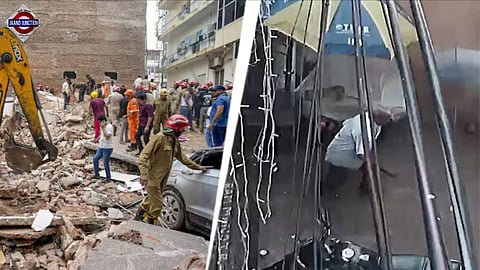

The Delhi High Court on Monday allowed the urgent listing of a Public Interest Litigation (PIL) concerning the deadly building collapse in South Delhi’s Satya Niketan.
The matter was mentioned before a bench comprising Chief Justice Devendra Kumar Upadhyaya and Justice Tejas Karia, with the petitioner seeking an urgent hearing in view of the seriousness of the incident. The court permitted the petition to be listed during the day.
The development comes as rescue and relief operations continue following the collapse of a multi-storey building in Satya Niketan that was being used as a boys’ PG accommodation.
During the hearing, the lawyer drew the court’s attention to the incident and the large number of students who were initially feared trapped under the debris.
The petition seeks urgent judicial intervention into the circumstances surrounding the collapse and the broader issue of safety and regulatory oversight of buildings being used as student accommodation.
The court’s decision to allow an urgent hearing brings the spotlight onto not just the building owner, but also the regulatory mechanisms responsible for ensuring that such structures are safe for occupation.
The collapse has triggered questions over the condition of old buildings, unauthorised construction, renovation work and the functioning of municipal oversight in areas packed with student accommodation.
The building that collapsed was being used as a PG near Delhi University's South Campus, an area where large numbers of students depend on private hostels and paying guest facilities.
According to reports, repair work was underway when the structure collapsed. The exact cause of the collapse remains under investigation.
The tragedy has consequently turned into a larger debate over whether privately operated PGs and hostels are being adequately inspected and regulated.
The judicial intervention comes alongside action announced by the Delhi government.
Delhi Chief Minister Rekha Gupta has ordered strict action following the incident. Five MCD officials — including a Deputy Commissioner, Executive Engineer, Superintending Engineer, Assistant Engineer and Junior Engineer — have been suspended.
The building owner has also been arrested, while authorities have ordered inspections of nearby PGs and buildings and a crackdown on structures with unauthorised fifth floors.
The government has said that anyone found responsible for the tragedy will face action.
The urgent PIL could potentially widen the scope of accountability beyond the immediate circumstances of the collapse.
The court may examine questions around:
Safety standards in private PGs and hostels
Municipal inspections and enforcement
Unauthorised construction
Structural safety of ageing buildings
Renovation and repair work in occupied buildings
Responsibility of authorities overseeing student accommodation
The incident has already prompted calls for a broader safety audit of PGs and student housing across Delhi.
For now, the High Court's decision to urgently list the PIL ensures that the Satya Niketan tragedy is not treated merely as an isolated building-collapse case, but as a potential public-safety and regulatory failure requiring judicial scrutiny.
With the rescue operation, criminal investigation and administrative action underway, the court hearing could become another crucial step in determining who was responsible — and whether the tragedy could have been prevented.
