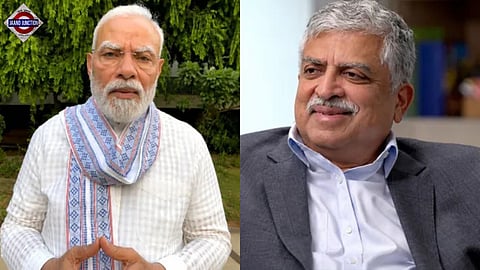

Prime Minister Narendra Modi on Sunday announced the formation of a high-powered task force headed by tech giant Infosys co-founder Nandan Nilekani to recommend reforms in India's examination system.
In a video message shared on X, the Prime Minister said the Centre has been taking several steps to safeguard the future of students. He said those who "played with the future of students" are now in jail.
The PM said the government has already introduced a fast-track court and is also moving towards bringing a new law with stringent provisions in Parliament to deal with examination-related irregularities.
Emphasising the need for long-term reforms, the Prime Minister said the government is focusing on making the examination system more reliable and transparent while ensuring greater use of technology.
The task force will focus on examination reforms and submit its recommendations at the earliest. He said the government will act on the basis of the panel's report to ensure the credibility of upcoming examinations.
The high-powered task force has been constituted for National Testing Agency (NTA) examination reforms. It is a multidisciplinary group of domain experts that will help revamp NTA examinations, particularly from a technology perspective, while also recommending structural reforms in the system.
The members of the task force are technology expert Nandan Nilekani, former Indian Space Research Organisation (ISRO) Chairman S Somnath, former Intelligence Bureau (IB) Director Tapan Deka, IIT Madras Director V. Kamakoti, former Education Secretary Anita Karwal, and logistics expert Amrit Lal Meena.
The panel was formed a day after Dharmendra Pradhan resigned as Union Education Minister, following nearly seven weeks of CJP-led student and youth protests over paper leaks that began at Jantar Mantar and later spread across the country.
The protest, which began on June 20, intensified following police action against demonstrators on July 20 and later drew support from several student organisations and activists, including Wangchuk, who undertook a prolonged hunger strike in solidarity with the movement.
The Union government is set to table the Public Examinations (Prevention of Unfair Means) Amendment Bill, 2026 in the Lok Sabha on Monday, July 27, as it seeks to strengthen the legal framework against examination-related fraud. The amendments are aimed at strengthening the 2024 law by introducing harsher punishments, ensuring time-bound investigations and trials, and creating special fast-track courts to ensure speedy justice.
The Public Examinations (Prevention of Unfair Means) Amendment Bill, 2026 seeks to significantly strengthen India's legal framework against examination malpractices by introducing tougher penalties, faster investigations, and time-bound trials.
The proposed amendments aim to improve accountability, deter organised examination-related fraud, and restore confidence in the country's public examination system.
Source: India Today

