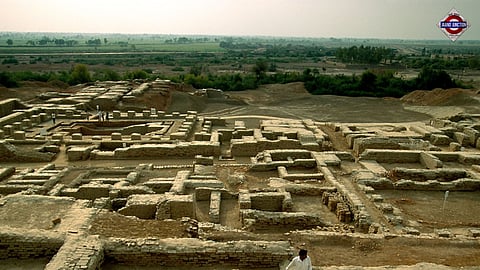

Archaeologists have unearthed evidence revealing that Mohenjo-Daro, the ancient city in current Pakistan, is much older than previously estimated. They have dated a major city wall to around 2700 to 2600 BCE, pushing back its rise by hundreds of years. This finding changes the narrative about one of the largest cities of the ancient Indus Valley Civilisation. The settlement was home to at least 40,000 people and remained prosperous for centuries before being abandoned in 1700 BCE. Signs that Mohenjo-Daro started building much earlier have been found in a buried mudbrick at the base of the western wall, Earth.com reported. The Sindh Directorate General of Antiquities & Archaeology (DGAA) stated that this was evidence that a wall was present in this place years before the city was believed to have put its first building blocks. The discovery of older pottery under the wall hints at a settlement before the first recorded fortification.
Mohenjo-Daro was a well-planned city with more than 700 wells and a drainage system that moved the waste out. The UNESCO World Heritage site is spread across 593 acres in Sindh, where brick homes once stood in a highly organised fashion, unusual for that time and age. Baked brick, tight joints, and sloped floors were constructed to allow dirty water to flow and not soak the walls. Its peak urban period did not happen by chance, but was the result of planning and skill. Researchers said that the western part of the city continued to change as the city grew. Structures were rebuilt over the years as development took place, with larger public works being established. “The walls were expanded and maintained until around 2200 BCE and possibly even longer,” the DGAA said in the statement.
The latest finding of a much older wall proves that growth happened in steps, as till now, Mohenjo-Daro's urban rise was placed at around 2500 BCE. The older stage of the ancient city is known as the Kot Diji phase, a time before urbanism spread. To find something so old, yet new, is not astonishing, as only one-third of the city has been excavated since the first digs took place in 1922. Salt damage and a high groundwater level still hide a major portion of its history. DGAA said that work will continue to discover more of the history of the area. “Future investigations will trace the plan of the city wall around the Stupa Mound in order to try and locate gateways,” it said in the statement. Mohenjo-Daro was abandoned around 1800 to 1700 BCE, and archaeologists are yet to figure out what went wrong. There have been suggestions of invasions and massacres, yet the relics do not point to such an event. However, climate change has emerged as one of the most plausible reasons after a 2025 study traced four long droughts.
