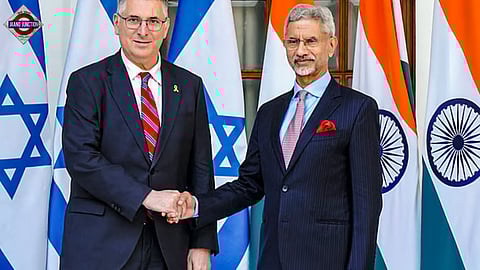

External Affairs Minister S Jaishankar on Thursday said he spoke to Israeli foreign minister Gideon Sa’ar to discuss the “many repercussions" of the ongoing West Asia conflict.
Jaishankar, who has been in touch with Israel and Iran, as well as the Gulf countries since the war started on February 28, said he exchanged views with Sa’ar on the escalating situation.
“Had a telecon with FM of Israel this evening. Exchanged views on the ongoing West Asia conflict and its many repercussions," Jaishankar wrote in a post on X.
Earlier, too, Jaishankar had urged de-escalation through dialogue to both Israel and Iran to end the violence, which has now spiralled into a full-fledged conflict that has caused a blockade in the Strait of Hormuz – a key energy artery – and upended global markets.
At an inter-ministerial press briefing, the ministry of external affairs (MEA) said as the conflict in West Asia widened with global ramifications on the 20th day, India remains in touch with concerned countries not only for its energy security needs, but to also promote the route of dialogue and diplomacy to end the hostilities between Iran and US-Israel. In the last 24 hours, Prime Minister Narendra Modi has also spoken to some Gulf countries as well as France to carry forward the message of peace and stability in the region.
The MEA said the situation has been a “testing time", not just for the country but the entire global community. Spokesperson Randhir Jaiswal said: “We continue to remain in touch with concerned countries to ensure our energy security needs are met."
The West Asia conflict began on February 28 when the US-Israel combine launched military strikes on Iran. In retaliation, Tehran has targeted Gulf countries hosting US military bases.
“Yes, it has been testing time, not just for us, but the entire global community. Our leaders have been in touch with their counterparts, as I just spoke about the conversation between our prime minister and the Crown Prince of Kuwait. Similarly, we have been in touch with several other leaders," Jaiswal said.
He was asked if the conflict has proven to be a test of India’s diplomatic approach in challenging global scenarios.
“Couple of days back you saw that because of our engagement, we were able to… and with talks and diplomacy with several of the stakeholders, we were able to get two of our LPG ships through the Strait of Hormuz," he said. “…So, our diplomatic efforts continue, and we are committed to taking care of our interests."

