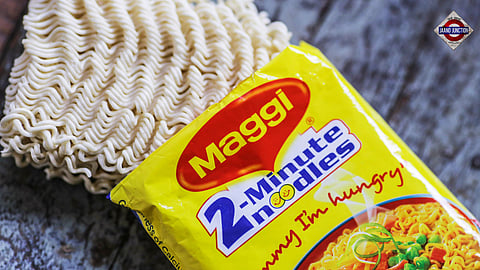

MUMBAI: Nestlé India has barely finished celebrating its legal clean slate before the regulators came knocking again. On 12th June, the Food Safety and Standards Authority of India (FSSAI) issued a formal notice to the company after verified consumer complaints and photographs circulating on social media alleged that live insects and larvae had been found inside sealed packets of Maggi noodles. Nestlé has 15 days to respond with a full action taken report, including manufacturing batch codes, supply chain logs and internal quality audit records. The stock wobbled on the news.
For a brand that contributes roughly 30 per cent of Nestlé India’s total domestic revenue, the timing could hardly be worse. Or, depending on your sense of irony, more fitting.
The catastrophe that nearly finished Maggi
Rewind to May 2015. Food safety inspectors in Uttar Pradesh found what they claimed were dangerously high levels of lead and monosodium glutamate in routine samples of Maggi noodles. Regulators alleged lead levels of up to 17.2 parts per million, nearly seven times the statutory limit of 2.5 parts per million. Nestlé disputed the methodology vigorously, arguing that the tastemaker powder should be tested as part of the finished, ready-to-eat product rather than in isolation. Nobody was listening.
On June 5th, 2015, the FSSAI declared Maggi “hazardous” and ordered an immediate nationwide recall. What followed was a corporate horror show. Nestlé was forced to destroy roughly 38,000 tonnes of noodles, paying an estimated Rs 20 crore to a cement plant just for the incineration. The total financial hit, covering the recall, stock destruction and temporary plant closures, came to between Rs 320 crore and Rs 450 crore. The company posted its first quarterly loss in three decades. In August 2015, the Union Ministry of Consumer Affairs piled on, filing a landmark class-action suit before the National Consumer Disputes Redressal Commission seeking Rs 640 crore in damages for unfair trade practices and misleading advertisements.
At its peak before the ban, Maggi had commanded between 75 per cent and 80 per cent of India’s instant noodle market. During the five-month ban, that share fell to zero.
The comeback
The ban did not survive legal scrutiny for long. In August 2015, the Bombay High Court struck it down, noting pointedly that the laboratories used by the authorities were not accredited by the National Accreditation Board for Testing and Calibration Laboratories. The court ordered fresh testing at properly accredited labs in Jaipur, Hyderabad and Punjab. Maggi cleared those tests and was back on shelves by November 2015.
What followed was a textbook crisis recovery. Through a combination of aggressive advertising, emotional brand communication and sheer consumer nostalgia, Maggi clawed its way back. By the early 2020s it had recaptured over 60 per cent of the instant noodle market.
The legal ghosts are laid to rest
Nearly a decade of litigation ground slowly toward resolution. In April 2024, the NCDRC dismissed the central government’s Rs 640 crore class-action suit, ruling that the government had produced no viable scientific evidence of Consumer Protection Act violations. Tests conducted by the Central Food Technological Research Institute in Mysuru confirmed that lead levels in the contested samples were well within permissible limits.
The legal clean-up concluded in early 2025 when the Bombay High Court quashed a residual criminal case filed by a local food safety officer in 2016, ruling that because the original sample had been tested in a state laboratory lacking proper accreditation or official recognition by the food authority, the case had no legal validity whatsoever.
Nine years of regulatory and legal siege, over.
And then came 12th June, 2026
Analysts are cautious about drawing direct parallels with 2015. The current episode is being characterised as a sentiment-driven volatility event rather than a systemic risk, and there is no suggestion yet of a nationwide safety failure. But Nestlé knows better than most how quickly Indian consumer sentiment can curdle when Maggi is in the headlines for the wrong reasons.
The company must now hand over its manufacturing batch codes, supply chain logs and quality audit reports, and demonstrate what corrective measures are being put in place across its production lines. The FSSAI has given it 15 days.
Maggi has survived a nationwide ban, 38,000 tonnes of incinerated noodles, a Rs 640 crore government lawsuit and nearly a decade in court. Whether it can survive the internet seeing insects in a sealed packet is, for now, the only question that matters.

