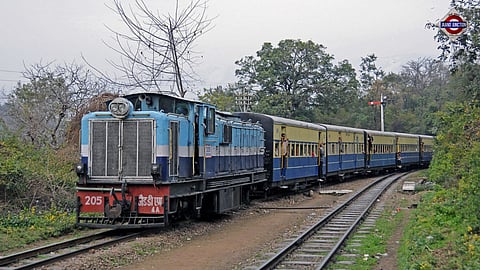

A little-known Himalayan toy train route, often overshadowed by the famous Kalka-Shimla Railway, is back on track after nearly four years. The colonial-era Pathankot-Jogindernagar narrow-gauge line, which winds through the scenic Kangra Valley, resumed operations last week. And, the ride along the route is as good as its cousin, the Kalka-Shimla Railway.
Ruskin Bond has written volumes on Himalayan railways. Though he didn't write much about this route, it carries the same old-world charm that runs through his stories set in the "Dehra".
Heading to Himachal Pradesh, most tourists hop onto the iconic Kalka-Shimla toy train and crowd the crowded hill station further. But, tucked away northwest in the lower Himalayas is another mountain toy train route that isn't too well known. The sight of a growling ZDM-3D locomotive pulling tiny coaches beneath the snow-capped Dhauladhar range can rival the charm of its richer cousin, the Kalka-Shimla Railway, and just about any mountain rail journey in India.
The Kangra Valley Railway originates from Pathankot in northern Punjab and snakes through Himachal Pradesh's plains, hillocks, tea gardens, villages and river valleys. The last leg is under the shadow of the Dhauladhar mountains. Pro tip: sit on the left side.
We are talking about the Pathankot-Jogindernagar narrow-gauge route because it resumed operations last week after remaining partially suspended for nearly four years after damage caused by flash floods.
On August 20, 2022, flash floods in the Chakki Khad river washed away pillars and parts of the historic Chakki Bridge between Pathankot and Kandwal. Trains, however, continued on the 121-km Nurpur Road-Joginder Nagar segment.
On May 2, Union Minister Anurag Thakur greeted the train at Kangra Railway Station. The restart offers a chance to rediscover India's most underrated rail route. The timing could hardly be better. But those willing to wait a few weeks for monsoon would be rewarded with an even grander and greener spectacle.
The Kangra Valley Railway runs for around 164 kilometres between Pathankot in Punjab and Jogindernagar in Himachal Pradesh. Opened in 1929 during British rule, it connects temple towns like Jawalamukhi, tourist spots like Palampur and Baijnath, tea estates and dozens of villages scattered across the route.
The train runs beside the Pong Dam reservoir on the Beas River. It's scenic.
Unlike the Kalka-Shimla Railway, which climbs steeply and passes through tunnels and bridges to reach the former summer capital of British India, the Kangra line follows a gentler course through valleys and foothills. You'll see mustard fields, tea estates, streams, temples, distant villages and cattle, and old market towns before opening up to spectacular views of the snow-capped Dhauladhar range.
The train crosses more than 900 bridges. It remarkably has only a handful of tunnels. The scenery changes constantly.
That charm has earned the railway route a devoted following among rail fans, despite it being less popular.
Comparisons with the Kalka-Shimla Railway are inevitable since both are in Himachal Pradesh.
The Kalka-Shimla route is an engineering marvel. It has more than 100 tunnels, multi-arched bridges and a steep climb into the Himalayas. Its UNESCO World Heritage status has turned it into a tourist attraction, which it deserves
The Kangra Valley Railway offers a different experience. There is a touch of Ruskin Bond along this route. Almost every old-school station along the line demanded my attention during my visit in 2014.
The Kangra valley route is less about engineering, more about being determined to grab a window seat. You choose which side. The train moves through open valleys. There are no horseshoe curves or switchbacks like on the Shimla route. You could spend hours with uninterrupted views. There are fewer crowds, and fewer tourists.
My two friends kept returning to a refrain. Wordsworth's "bliss of solitude". Highway's Patakha Guddi was on our playlists.
The Kangra Valley Railway is unique. It's also part of the shrinking club of narrow-metre-gauge railways in India. What's a toy train then? Not all toy trains are the same.
When many think of toy trains, they usually imagine tiny narrow-gauge trains.
India's most famous toy train is the Darjeeling Himalayan Railway, which opened in 1881 and runs on a 610-mm narrow gauge between New Jalpaiguri and Darjeeling in West Bengal. It became the first of India's mountain railways to receive UNESCO World Heritage recognition.
The Kalka-Shimla Railway, inaugurated in 1903, runs on a wider 762-mm narrow gauge and is famous for its tunnels and bridges. It also has the UNESCO tag.
The Nilgiri Mountain Railway in Tamil Nadu is different again. It operates on metre gauge and uses a rare rack-and-pinion system to climb steep gradients between Mettupalayam and Ooty. Unlike ordinary railways, a toothed rail runs between the tracks and meshes with a cogwheel under the train. This helps the train to crawl up steep mountain gradients without slipping.
It operates both diesel and steam locomotives. This one also has the UNESCO tag.
Another underrated one is the Matheran Hill Railway in Maharashtra. It runs on a 610-mm narrow gauge and serves India's only automobile-free hill station.
The Kangra Valley Railway, built on a 762-mm narrow gauge, is not celebrated as it should be.
For years, there have been demands to convert the Pathankot-Jogindernagar line to broad gauge to improve speed and connectivity. In March 2026, the Ministry of Railways told Parliament that a field survey was underway for a Detailed Project Report on gauge conversion of the roughly 200-km route.
However, no approval for gauge conversion has been announced. The future of the Kangra Valley Railway is uncertain. As of now, the toy train is back where it belongs. Vande Bharats are meant to be faster. This one is to be remembered.
