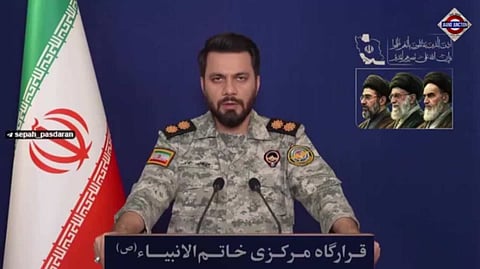

Earlier this week, US President Donald Trump asserted that negotiations to end the Iran war were on with leaders who are "more moderate" and "more reasonable". However, Iran has denied it. It has raised questions about who is in charge in Iran. It has now emerged that the powerful Islamic Revolutionary Guard Corps (IRGC) has effectively assumed control amid a power struggle with Iran president Masoud Pezeshkian, as per a report in Iran International.
In fact, such is the situation that Pezeshkian, known as a moderate leader, has been pushed into a "complete political deadlock". The IRGC, which is carrying out Iran's military response to US attacks, is now in control of key state functions, sources told Iran International.
Much of it is due to the absence of a Supreme Leader after US-Israeli strikes killed Ayatollah Ali Khamenei and most of the top leadership on the first day of the conflict. Days into the war, Ali Khamenei's son, Mojtaba, was named as the Supreme Leader. However, Mojtaba has not been seen or heard from since. Messages from the Supreme Leader have only been read out on live TV.
It has led to speculation that Mojtaba may have died. Latest reports, however, claim the Supreme Leader was likely in a coma. Trump has suggested that Mojtaba might be in a critical condition, while US Defence Secretary Pete Hegseth asserted that he was "disfigured".
It has left a political vacuum. And now, the IRGC, which operates independently of the regular army, seems to have seized control.
As per the report, a "military council" composed of senior IRGC officers are now taking daily decisions. In fact, the IRGC has established a strict security cordon around Mojtaba. Even government reports on the country's situation are prevented from reaching him, the report said.
Sources also said that the Iranian president's repeated requests to the IRGC for a meeting with the Supreme Leader have been ignored. In fact, there has been no contact between the political leadership and Mojtaba in recent days.
Besides, the IRGC has also blocked presidential appointments.
Last week, Pezeshkian's move to appoint Hossein Dehghan as intelligence minister failed after pressure from IRGC chief commander Ahmad Vahidi. Vahidi took over the powerful force after Mohammad Pakpour was killed during the war's opening phase.
Vahidi reportedly insisted that all vital and sensitive leadership positions should be selected and managed directly by the IRGC amid the conflict.
This is a departure from the traditional system, where presidents have nominated intelligence ministers after securing the approval of the Supreme Leader.
Murmurs of a rift between the IRGC and the president have been there since last week. Pezeshkian was upset with the IRGC's approach of escalating tensions in the region by continuing to target neighbouring Gulf countries. He had warned that it would have a long-term impact on the Iranian economy. Iran's economy is already on the verge of collapse after weeks of war that have depleted its ammunition.
The present situation is something several experts predicted weeks ago.
The IRGC, which began as a paramilitary force after the 1979 revolution, has long sought to concentrate power. Over the decades, the IRGC has developed a robust business empire that helps finance the regime. That empire encompasses core sectors like oil, transportation, banking, and real estate.
However, with the whereabouts of Mojtaba Khamenei not clear, the IRGC has further consolidated its grip over Iran. It is also the sole authority managing the Strait of Hormuz, the crucial oil transit waterway that has been effectively blocked by Iran.
At the same time, tensions have flared within Mojtaba's inner circle, the report said. Efforts are on to remove Ali Asghar Hejazi, a powerful senior security official, from the Supreme Leader's team.
advertisement
The anger against Hejazi stems from his opposition to Mojtaba Khamenei's succession. He had warned the Assembly of Experts, which chooses the Supreme Leader, that Mojtaba lacked the necessary qualifications for leadership and elevating him would effectively hand full control of Iran to the IRGC. It would thereby weaken civilian institutions, Hejazi warned.
The same seems to be unfolding now, with power now concentrated with the IRGC.
