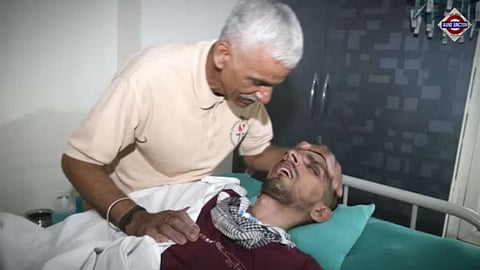

Harish Rana, the first person in India to be granted passive euthanasia by a court, died at the All India Institute of Medical Sciences, Delhi on Tuesday, bringing an end to a case that marked a significant moment in the country’s legal and medical history.
The 31-year-old had been in a vegetative state since 2013 after suffering severe head injuries in a fall from a fourth-floor balcony while he was a BTech student at Panjab University. For over a decade, he survived on artificial nutrition and intermittent oxygen support.
On March 11, the Supreme Court of India allowed passive euthanasia in Rana’s case, directing doctors to withdraw life support through a carefully planned process that ensured dignity.
Rana was shifted from his Ghaziabad home to the palliative care unit at AIIMS Delhi’s Dr BR Ambedkar Institute Rotary Cancer Hospital on March 14. A multidisciplinary team led by Dr Seema Mishra, head of anaesthesia and palliative medicine, was tasked with implementing the process -- considered the first of its kind in India.
The team included specialists from neurosurgery, onco-anaesthesia, palliative medicine and psychiatry, reflecting the complexity and sensitivity of the procedure.
Following established medical protocols, Rana’s artificial nutritional support was gradually withdrawn under close supervision, in line with the Supreme Court’s directive.
His case is being seen as a milestone in India’s evolving approach to end-of-life care, with a focus on dignity, medical ethics and legal safeguards.
The case had a long legal journey before reaching the apex court. Rana’s family had first approached the Delhi High Court in 2024 seeking permission to withdraw life-sustaining treatment, but the plea was rejected. They later moved the Supreme Court of India, which examined detailed medical assessments before delivering its March 11 verdict.
The court relied on the framework laid down in the 2018 Common Cause judgment, which recognises passive euthanasia as part of the right to die with dignity under Article 21.
Medical boards constituted during the proceedings concluded that Rana was in an irreversible vegetative state with negligible chances of recovery, forming the basis for the final decision.
The bench also urged the Centre to consider a comprehensive legal framework to guide such end-of-life decisions in future cases.
