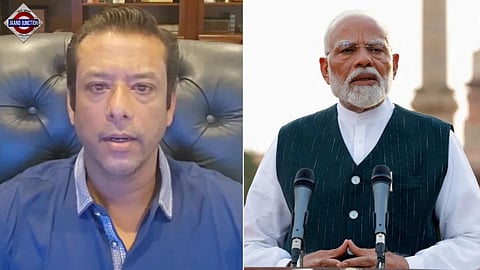

Sajeeb Wazed, son of Bangladesh’s ousted Prime Minister Sheikh Hasina, has credited India with preventing an assassination attempt on his mother during last year’s political upheaval, while slamming the interim administration in Dhaka and the judicial process that led to his mother’s death sentence.
Speaking to news agency ANI in Virginia, US, Wazed accused Bangladesh’s current rulers of manipulating laws, dismissing judges, and denying Hasina her constitutional rights.
Sajeeb Wazed, son of Bangladesh’s ousted Prime Minister Sheikh Hasina, has credited India with preventing an assassination attempt on his mother during last year’s political upheaval, while slamming the interim administration in Dhaka and the judicial process that led to his mother’s death sentence.
Speaking to news agency ANI in Virginia, US, Wazed accused Bangladesh’s current rulers of manipulating laws, dismissing judges, and denying Hasina her constitutional rights.
The verdict, the harshest ever against a Bangladeshi political leader, has drawn both jubilation and anger on the streets, as well as heightened tensions between Dhaka and New Delhi after Bangladesh formally sought Hasina’s extradition.
Wazed dismissed the proceedings as a political charade, alleging that the interim government, led by Nobel laureate Muhammad Yunus, had subverted due process at every stage.
“For an extradition to happen, the judicial process has to be followed. In Bangladesh, there is a government that’s unelected, unconstitutional and illegal. In order to convict my mother, they amended the laws to fast-track her trial. So these laws were amended illegally," he said.
“My mother was not allowed to hire her defence attorneys. Her attorneys weren’t even allowed into the courts," he added.
He further claimed the tribunal’s composition was engineered to ensure a predetermined verdict.
“Seventeen judges were terminated at the court before the trial, new judges appointed, some of whom had absolutely no experience on the bench and were politically connected. So, there was no due process whatsoever. For extradition to happen, there has to be due process," Hasina’s son said.
Hasina, who has rejected the tribunal as a “rigged" and “politically motivated" mechanism, had fled to India during unprecedented unrest that paralysed Bangladesh between mid-July and early August last year.
A UN assessment later estimated that up to 1,400 people were killed, most by gunfire from security forces, during the weeks-long uprising, which became Bangladesh’s deadliest political crisis since its 1971 independence.
The interim government has defended the trial as transparent and lawful, insisting the judgment reflected the severity of the actions attributed to the former prime minister.
The verdict comes as the country prepares for elections in February, with the Awami League currently barred from participating, a restriction Wazed warned could trigger further violence.
Meanwhile, security across Bangladesh remains tight.
In recent days, dozens of crude bombs were detonated and vehicles set ablaze ahead of the ruling, prompting heavy deployments around government buildings and judicial complexes.

