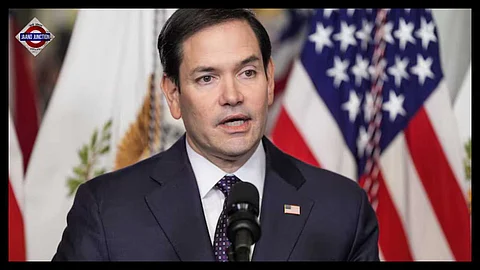

US Secretary of State Marco Rubio has said that India has assured Washington of its commitment to refrain from purchasing additional Russian oil, amid fresh sanctions imposed by the United States on Moscow’s energy sector.
"The United States has imposed additional sanctions on Russia's oil. In our conversations with India, we've gotten their commitment to stop buying additional Russian oil. Europe has taken its set of steps moving forward," Russian news agency Tass quoted Rubio as saying at the Munich Security Conference on Saturday.
His remarks come as the US intensifies efforts to restrict Russia’s energy revenues following the prolonged conflict in Ukraine.
Meanwhile, speaking at the same Conference, External Affairs Minister S Jaishankar reaffirmed India’s commitment to strategic autonomy amid questions over whether the recent trade agreement with the US would compel New Delhi to scale back Russian oil imports.
"We are very much wedded to strategic autonomy because it's very much a part of our history and our evolution. It's something which is very deep, and it's something which cuts across the political spectrum as well," Jaishankar said.
On energy purchases, he described the global oil market as complex, noting that companies assess availability, costs and risks before making decisions in their best interest.
Acknowledging shifting geopolitical dynamics, he said countries are constantly recalibrating their positions. However, he made clear that India would retain an independent approach. "But if the bottom line of your question is, would I remain independent-minded and make my decisions? Yes, it can happen".
India has significantly increased its imports of discounted Russian crude since the outbreak of the Ukraine war, citing energy security and economic considerations. However, Rubio’s statement suggests ongoing diplomatic engagement between Washington and New Delhi on the issue.
Rubio’s remarks on India’s Russian oil imports came more than a week after US President Donald Trump claimed that New Delhi had agreed to halt such purchases as part of a broader understanding between the two countries.
While announcing a deal after more than a year of trade tensions, Trump said, "India agreed to stop buying Russian oil and buy more from US," framing the move as a breakthrough in bilateral economic ties.
A major sticking point during the prolonged negotiations was India’s continued import of discounted Russian crude, which Trump repeatedly flagged as a concern.
Throughout the period of strained trade relations, Trump publicly pressed India to scale back its Russian oil purchases amid the ongoing war in Ukraine.
He repeatedly warned of imposing higher tariffs and additional levies if India did not reduce its dependence on Russian energy supplies.
At one point, he sharply criticised New Delhi’s position, saying India does not "care how many people in Ukraine are being killed by the Russian War Machine," underscoring the intensity of US pressure on the issue.
Earlier, Russian Foreign Minister Sergey Lavrov dismissed reports of any such assurance, saying that no one besides US officials had spoken about India possibly halting Russian oil imports. He added that the Indian government had never made such statements.
The differing accounts highlight the sensitive geopolitical balancing act India faces amid Western sanctions and its longstanding ties with Russia.
Despite the US pressure, India held its position. Prime Minister Narendra Modi and External Affairs Minister S Jaishankar made it clear that the government would act in the country’s best interests, even if it meant ruffling feathers internationally.
India currently imports nearly 35 per cent of its total crude oil requirements from Russia, a shift that accelerated after Western sanctions reshaped global energy flows.
Notably, India had already begun diversifying its energy imports, with US crude now accounting for nearly 10 per cent of its total oil imports.
New Delhi also signed a liquefied petroleum gas (LPG) agreement under which Indian public sector refiners inked a one-year deal for American LPG imports.
In addition, India passed the Sustainable Harnessing and Advancement of Nuclear Energy for Transforming India (SHANTI) Bill, 2025, opening the tightly regulated nuclear power sector to private participation, another long-standing US demand.

