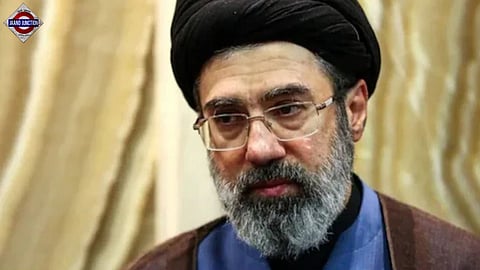

Questions are growing over the condition and whereabouts of Iran’s new supreme leader Mojtaba Khamenei, as new details emerge about injuries he suffered at the start of the war. A recent Reuters report, citing three sources close to his inner circle, says he is still recovering from serious wounds sustained in an airstrike that killed his father, Ali Khamenei.
According to the sources, Khamenei suffered severe facial injuries and damage to one or both legs when the strike hit the supreme leader’s compound in central Tehran. His face was reportedly disfigured in the attack. Despite this, the 56-year-old is said to be mentally alert and actively involved in decision-making.
He is currently participating in high-level meetings through audio conferencing and remains engaged in key issues, including the ongoing war and negotiations with Washington.
There has been no public appearance by Khamenei since the attack on February 28. No images, videos or audio recordings have been released since he was appointed supreme leader on March 8 following the death of his father, Ali Khamenei.
Iran’s United Nations mission has not responded to questions about his condition or absence. There has also been no official confirmation from Tehran on the extent of his injuries. However, a state television newsreader referred to him as a “janbaz", a term used for those seriously wounded in war.
The reported injuries align with remarks made by Pete Hegseth, who said in March that Khamenei was “wounded and likely disfigured". A source familiar with US intelligence assessments told Reuters that he may have lost a leg, though this has not been independently verified. The CIA declined to comment, and Israel’s prime minister’s office did not respond.
Khamenei’s health has become a key issue as Iran faces one of its most difficult moments in decades, with high-stakes talks with the United States set to begin in Islamabad. His ability to lead effectively remains uncertain.
Experts say that even if he recovers physically, consolidating power could take time. Alex Vatanka noted that Khamenei is unlikely to wield the same authority as his father in the near term. While he represents continuity, he will need to establish himself as a dominant voice within the system.
In Iran’s system, the supreme leader holds ultimate authority, overseeing the elected government and commanding powerful institutions such as the Revolutionary Guards. While Mojtaba Khamenei had influence in his father’s office, insiders say he does not yet command the same level of control.
During the current conflict, the Revolutionary Guards have emerged as a key force shaping strategic decisions.
Khamenei’s absence has sparked widespread speculation on Iranian social media, with rumours and conspiracy theories circulating about his condition. One viral image shows an empty chair with the caption: “Where is Mojtaba?"
Some supporters argue that staying out of public view is necessary for security reasons, given ongoing US and Israeli strikes. Sources suggest that images or a public appearance may come within one or two months, depending on his recovery and the security situation.
