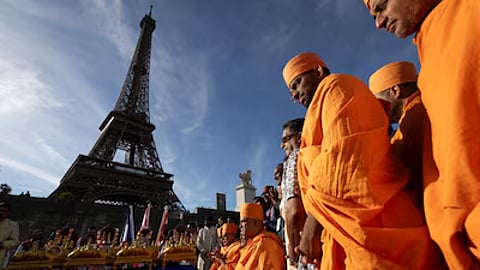

The controversy surrounding BAPS and the Eiffel Tower has taken a significant turn after a Paris investigation found that the Hindu organisation did not explicitly ask for female employees to be removed during its private visit to the monument earlier this month.
An investigation by the General Inspectorate of the City of Paris found no written instruction from the BAPS delegation asking that women be excluded from the visit. According to Le Parisien, the investigation concluded that the incident resulted from a “collective dysfunction”, with a message apparently becoming distorted as it passed through different levels of communication.
The findings provide important context to a controversy that had previously led to a staff protest, the temporary closure of the Eiffel Tower and widespread criticism in France.
What exactly did the investigation find?
According to the findings reported by Le Parisien, investigators found no explicit request from the Hindu religious delegation to exclude women from the entire procession.
More importantly, investigators reportedly found no written document or email from BAPS requesting that female employees be removed.
The report said the decisions were made “between consenting adults”, while an elected Paris official told Le Parisien that the original message had been distorted as it was passed on verbally.
The investigation therefore points towards a chain of internal decisions and miscommunication at the Eiffel Tower rather than a documented order from BAPS to remove women workers.
So what was the original request?
This is where the latest findings become particularly important.
The investigation reportedly found that the initial request communicated to the Eiffel Tower’s operating company, SETE, concerned limiting physical contact between religious figures and women, as reported by Hindustan Times.
That request was subsequently interpreted and implemented much more broadly.
According to the investigation, security posts were assigned to male employees on the morning of the visit, including positions at the elevators. Employees working at reception and customer relations were also asked to temporarily leave certain areas while part of the delegation ascended the North Pillar.
In other words, the probe suggests that a request concerning interaction was transformed into operational instructions that resulted in female employees being sidelined.
That distinction is central to understanding what happened.
BAPS had denied asking for women to be removed
BAPS had already rejected the suggestion that it had asked the Eiffel Tower to remove women workers.
Following the initial controversy, the organisation said the private visit had been coordinated with Eiffel Tower management and scheduled at the beginning of normal opening hours because of the size of its delegation.
BAPS also said that, to its knowledge, no one was denied access to the Eiffel Tower, while apologising for any pain or inconvenience caused by the incident.
The latest investigation now broadly supports BAPS’s central denial that there was an explicit request to exclude women from the entire visit.
But the women were still sidelined
The new findings do not mean that nothing happened.
Female employees were in fact sidelined during the September 5 visit, according to the investigation and statements from Eiffel Tower staff.
Earlier, employees said women had been asked to leave their positions, with some replaced by male colleagues, while others were instructed not to enter or pass through certain areas while the delegation was present.
That incident triggered anger among employees and eventually led to a staff walkout.
The Eiffel Tower was closed for a day as workers protested the treatment of their female colleagues.
So the investigation’s conclusion is not that the exclusion didn’t happen.
It is that investigators found no explicit written request from BAPS ordering that women be excluded.
The message apparently changed along the way
This may ultimately be the biggest lesson from the investigation.
According to the findings, a request relating to contact between religious figures and women appears to have travelled through several layers of management and operational planning.
By the time the visit took place, it had apparently become instructions affecting the positions and movements of female employees.
A Paris elected official described the problem as a message that had been “distorted” as it circulated by word of mouth.
That chain of communication is now at the centre of the controversy.
The question is no longer simply:
“Did BAPS ask for women to be removed?”
It is also:
“Who interpreted the request that way, who approved the resulting arrangements, and why?”
Eiffel Tower management still faced serious consequences
The findings have not erased the responsibility of Eiffel Tower management.
Patrick Branco Ruivo, who has headed the company operating the Eiffel Tower since 2018, is stepping down at the end of 2026.
The operating company, Société d’Exploitation de la Tour Eiffel (SETE), previously said an internal investigation had uncovered “operational flaws and shortcomings” in the planning and organisation of the September 5 visit, which resulted in the unacceptable exclusion of female staff.
The leadership change therefore remains a consequence of the operational failure surrounding the visit.
Why the controversy became so explosive
The incident touched an especially sensitive nerve in France.
The Eiffel Tower is not merely a tourist attraction. It is one of France’s most recognisable national symbols, and the treatment of women in public and professional life is closely tied to the country’s republican and equality principles.
When female employees said they had been sidelined because of their gender, the issue quickly moved beyond an internal workplace dispute.
French politicians criticised the incident, while the staff protest forced the monument to temporarily close.
The controversy also attracted international attention because it involved a Hindu religious delegation visiting one of France’s most iconic landmarks.
What about BAPS’s religious practices?
BAPS members were in France for events surrounding the inauguration of the organisation’s first traditional Hindu temple in the country.
The delegation included senior Hindu religious figures, including Mahant Swami Maharaj, who is 93. BAPS has explained that certain monks follow religious vows concerning physical contact with women.
BAPS itself has continued to deny that it sought to prevent women from working at the Eiffel Tower or that anyone was denied access.
The organisation’s own Paris events in September included a range of programmes, including a women’s convention, as part of its wider Festival of Culture.
