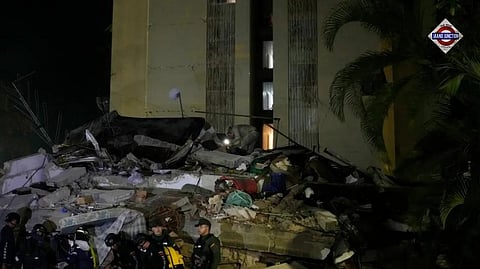

Venezuela was struck by two powerful earthquakes in quick succession, including a magnitude 7.5 tremor that became the strongest earthquake recorded in the country since 1900.
According to reports, the second and stronger earthquake occurred approximately one minute after an initial tremor. The 7.5-magnitude quake struck at a depth of around 10 kilometres, with its epicentre located near Morón. The back-to-back earthquakes triggered panic across affected regions, prompting residents to evacuate homes, offices and other buildings.
In the capital, Caracas, witnesses reported damage to several structures, including collapsed walls and debris falling onto streets. Residents gathered in open areas as emergency services began assessing the extent of the damage.
Authorities had not immediately released an official nationwide casualty figure. However, local officials and eyewitnesses reported collapsed buildings, rescue operations and multiple injuries. The United States Geological Survey (USGS) warned that significant casualties and extensive damage were possible, noting that the disaster could be widespread. Officials stressed that the full impact of the earthquake was still being evaluated.

The earthquakes also prompted tsunami alerts in parts of the Caribbean. The US Pacific Tsunami Warning Center issued warnings for the Virgin Islands, while authorities in the Dominican Republic advised residents to remain alert for possible sea-level changes. A precautionary alert for Puerto Rico was later lifted.
Emergency response teams continued to monitor aftershocks and assess structural damage as authorities urged residents to follow safety instructions.
Hours later, Japan experienced a separate major earthquake measuring 6.9 in magnitude off its northeastern coast. The Japan Meteorological Agency (JMA) said the quake occurred beneath the seabed near Iwate Prefecture at a depth of approximately 50 kilometres.
The tremor was felt across several prefectures in the Tohoku region, with Aomori Prefecture recording some of the strongest shaking. Authorities stated that while minor sea-level fluctuations were possible, there was no threat of a destructive tsunami.
The Japanese government established an emergency task force to coordinate information gathering and disaster response efforts. Chief Cabinet Secretary Minoru Kihara said officials were closely monitoring the situation and were prepared to provide assistance if required.
Safety inspections conducted after the earthquake found no abnormalities at nuclear facilities. Operators of the Onagawa nuclear power plant and other sites reported normal operations, while Japan's Nuclear Regulation Authority said no damage had been detected.
The earthquake also caused temporary disruptions to transportation services. Several rail services, including sections of the Tohoku Shinkansen high-speed line, were suspended for inspections, and parts of expressways were temporarily closed as a precaution.
Both countries continue to assess the impact of the earthquakes, with authorities focusing on rescue efforts, damage assessments and public safety measures.
Sources: The Indian Express
