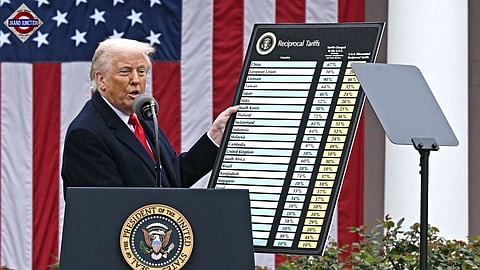

In a ruling that is set to have riveting global implications, the US Supreme Court on Friday struck down President Donald Trump’s sweeping tariffs imposed under a national emergency law, dealing a major blow to one of his most aggressive economic policies and reshaping the trajectory of the global trade war he reignited after returning to office, news agency Reuters reported.
In a 6-3 decision authored by Chief Justice John Roberts, the court upheld a lower court ruling that Trump exceeded his authority by invoking the International Emergency Economic Powers Act (IEEPA) to levy broad import taxes.
The law, enacted in 1977, allows a president to regulate commerce during a national emergency but does not explicitly mention tariffs.
According to Reuters, Roberts wrote that "the president must 'point to clear congressional authorisation' to justify his extraordinary assertion of the power to impose tariffs," adding- "He cannot".
The ruling undercuts a central pillar of Trump’s second-term economic agenda. Tariffs — taxes on imported goods — have been central to his strategy to reduce trade deficits, pressure trading partners and raise federal revenue.
The measures triggered volatility in financial markets, strained diplomatic ties and fuelled uncertainty in the global economy.
The US Constitution grants Congress the authority to impose taxes and tariffs. Trump bypassed lawmakers by relying on IEEPA to impose duties on nearly all major US trading partners, becoming the first president to use the statute in this manner.
While he imposed some tariffs under other laws, those were not part of the case before the court.
The legal challenge was brought by small businesses affected by the tariffs and by 12 Democratic-governed states.
Lower courts had ruled against the administration, finding that IEEPA did not grant the president unlimited tariff authority. The Supreme Court’s decision affirms that view.
Trump had defended the tariffs as essential to economic security. He warned that without them the US would be "defenceless" and said in November that without his tariffs "the rest of the world would laugh at us because they’ve used tariffs against us for years and took advantage of us".
He frequently cited China, the world’s second-largest economy, as an example of unfair trade practices.
Economists at the Penn-Wharton Budget Model estimated that tariffs imposed under IEEPA had generated more than USD 175 billion.
With the court invalidating those duties, the Trump administration may need to refund much of that revenue.
The Congressional Budget Office had projected that all current tariffs, including those based on IEEPA, would generate about USD 300 billion annually over the next decade. Total US net customs duty receipts reached a record USD 195 billion in fiscal 2025, according to Treasury data.
The Supreme Court’s decision has significant implications for US-India trade ties, which had come under strain amid Washington’s aggressive trade posture.
India was among the first countries affected by Trump’s "reciprocal" tariffs announced on April 2, which he dubbed "Liberation Day".
Invoking the IEEPA, Trump framed persistent US trade deficits — including with India — as a national emergency.
He repeatedly criticised India’s tariff structure, targeting duties on American agricultural products, medical devices and motorcycles, and accused New Delhi of maintaining unfair trade barriers.
India’s purchases of discounted Russian oil during the Ukraine war also drew criticism, with Trump signalling that tariffs could be used as leverage.
Indian officials engaged in negotiations in Washington to protect key export sectors such as pharmaceuticals, textiles and IT services.
The tariff threats unsettled exporters and markets in Mumbai, given bilateral trade exceeding USD 190 billion annually.
After oral arguments, Trump said he would pursue a "game two" plan if the court ruled against him.
Treasury Secretary Scott Bessent indicated the administration would explore alternative legal tools, including national security and unfair trade provisions, to preserve tariffs. However, these lack the sweeping flexibility IEEPA provided.
Historically used for sanctions, IEEPA was signed into law by President Jimmy Carter. While the ruling eases immediate pressure on India, reports claim that trade tensions may persist as Washington considers new legal pathways to sustain its tariff strategy.

