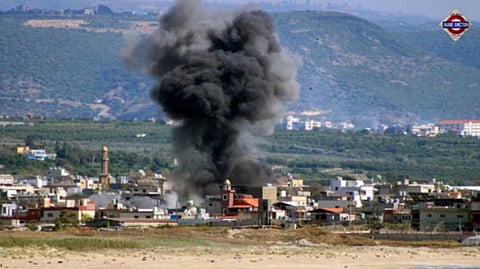

Tehran: The US military has launched new strikes on southern Iran, targeting Iranian missile sites and boats attempting to place mines, in what it described as a 'self-defence' action. The attacks came even as Tehran's top negotiators were in Doha for talks with Qatar's prime minister on a potential deal to end the three-month-old war with the US and Israel.
US Central Command (CENTCOM), in a statement, said the fresh strikes were taken in "self-defence", "to protect our troops from threats posed by Iranian forces". According to the US agency, the targets included missile launch sites and boats trying to "emplace mines".
Tim Hawkins, a US Central Command spokesman, said the American military "continues to defend our forces while using restraint during the ongoing ceasefire".
According to a New York Times report, he said the US target was an area near Bandar Abbas, a southern port city and home of an Iranian naval base that sits on the Strait of Hormuz.
Iranian state media also earlier reported that local officials in Bandar Abbas were investigating after three explosions were heard. According to the Islamic Revolutionary Guard Corps (IRGC), the sound of an explosion has been heard near Bandar Abbas airport. Iran's air defence system in Bandar Abbas “has been activated to counter hostile targets."
Bandar Abbas in southern Iran is the site of a key Iranian naval and air base and is strategically located along the Strait of Hormuz.
Iran's semi-official Fars News Agency, citing witnesses, also reported similar sounds were also reported in the Persian Gulf near Sirik and Jask.
The attacks came after Iran's armed forces reportedly said they had destroyed a hostile drone in the Persian Gulf area.
Tehran is yet to respond to the latest US strikes, and it remains unclear if the new American agression will have any impact on a potential peace agreement between the two warring nations.
However, Mohammad Bagher Zolghadr, the newly appointed hard-liner leader of the country's Supreme National Security Council, said in his first message to the Iranian people that “there will be no retreat” in Iran's fight against the United States and Israel.
“The military field, the diplomatic field and the people sent forth into the streets demonstrated this through their courageous resistance and brought the enemy to its knees,” he said, according to Iran's semi-official Tasnim News Agency.
The strikes come as a high-level delegation consisting of Iran's chief negotiator Mohammad Bagher Ghalibaf, Foreign Minister Abbas Araghchi and Central Bank Governor Abdolnaser Hemmati are in Doha for peace talks with the US, which, according to Iranian foreign ministry spokesman Esmail Baqai, have made some progress, but a deal to end the conflict "is not imminent". The attacks threatened an already fragile ceasefire that began on April 8 as Washington and Tehran struggle to reach an accord to end a war that has rattled the global economy with a severe disruption of energy flows.
Citing an official briefed on the Iranians' Doha visit, news agency Reuters reported that discussions focused on the Strait of Hormuz and Iran's stockpile of highly enriched uranium, while Iran's central bank governor attended to discuss the potential release of frozen Iranian funds as part of a final deal.
Hours after new US strikes, American President Donald Trump said in a social media post he expected Iran to hand over its enriched uranium to the United States to be destroyed or have it destroyed in Iran with an international witness.
"The Enriched Uranium (Nuclear Dust!) will either be immediately turned over to the United States to be brought home and destroyed or, preferably, in conjunction and coordination with the Islamic Republic of Iran, destroyed in place or, at another acceptable location, with the Atomic Energy Commission, or its equivalent, being witness to this process and event," Trump wrote.
It was not clear whether he meant this was part of an emerging accord with Iran. The Atomic Energy Commission that Trump cited was abolished in 1974, and its functions were divided between two successor bodies.
Earlier on Monday, the American President said it should be mandatory for Saudi Arabia, the United Arab Emirates, Qatar, Pakistan, Egypt, Turkey, Bahrain and Jordan to sign up to the Abraham Accords, a set of agreements brokered in 2020 with nations historically hostile to Israel, as part of a peace deal with Iran. The American commander-in-chief said he had spoken to the leaders of those countries about efforts to end the war with Iran. Bahrain and the UAE have already signed the accords, along with Morocco and Sudan.
While the Abraham Accords were welcomed by some, they remain deeply unpopular in many parts of the Middle East -- in part because they fail to address the Israeli-Palestinian conflict. Gulf heavyweights like Saudi Arabia and Qatar have said they will never normalise ties with Israel unless an independent Palestinian state is created.
