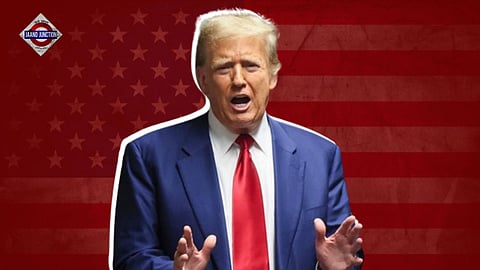

US President Donald Trump has claimed that Washington now has “almost total control” of the Strait of Hormuz and that Iran’s economy is “totally collapsing”, as tensions between the two countries escalate amid an intensifying exchange of strikes.
In a post on Truth Social, that came just hours after the US launched a fresh wave of airstrikes against Iran, Trump dismissed a report by ABC News that he was trying to force Tehran back to the negotiating table, saying he was not interested in pushing Iran into an agreement.
“I’m not trying to force Iran to the bargaining table, as ABC Fake News reported. I couldn’t care less if they sign a worthless, to them, agreement,” the President said, adding that he preferred the current situation, with what he described as “almost total control of the Hormuz Strait” and an Iranian economy that was “totally collapsing”.
“They are just playing out the inevitable."
Trump then directly called on the Iranian population to challenge the government. “When are the Iranian people going to rise up and fight?”

Since the conflict erupted in February, Trump has claimed multiple times that the US has established control over Hormuz. Tehran, however, has rejected Washington’s assertions and maintained that the strategic waterway remains under Iranian control.
Trump’s remarks came after the US launched a barrage of airstrikes against Iranian targets on Tuesday, triggering retaliation from Tehran against US assets and bases in Jordan, Bahrain and Iraq.
The fresh strikes followed a weekend exchange of fire — the first since July — and attacks on Monday on two tankers leaving Hormuz.
As a result, global oil prices rose more than $4 a barrel on Tuesday, settling at a five-week-high.
The latest escalation has further intensified the standoff over Hormuz, a critical global energy route that Iran has effectively closed to shipping. The Islamic Revolutionary Guard Corps said the US strikes would “tighten the lock” on the strategic waterway.
Iranian officials have warned that if Tehran is prevented from exporting oil through the Gulf, no other country would be able to do so either.
Trump, meanwhile, has rejected the prospect of another ceasefire, saying an agreement with Tehran “isn't worth the paper it's written on” and that Iran had already been given enough chances.
The latest US-Iran confrontation follows months of heightened tensions and a previous deal reached in June that quickly broke down, with control of Hormuz emerging as one of the central sticking points.
