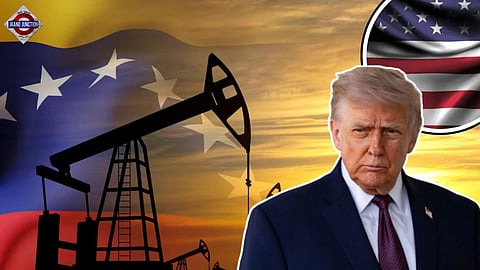

US President Donald Trump on Friday announced what he described as an unprecedented move to secure majority US control of more than 65 billion barrels of Venezuela's proven oil reserves through a partnership with private companies.
Trump said the arrangement, reached after weeks of negotiations between Washington and Caracas, would give the United States access to a significant share of Venezuela's vast oil reserves at no cost to American taxpayers.
In a post on Truth Social, Trump said Secretary of State Marco Rubio and Secretary of War Pete Hegseth had worked with Venezuela's interim President Delcy Rodriguez and private businesses to secure the agreement.

The announcement came as Venezuelan officials prepared to sign agreements next week granting new oil exploration and production rights to several companies, particularly US firms.
Sources had earlier said a lease model was being considered, under which Venezuelan oilfields could be auctioned to US producers. However, such an arrangement could face legal and constitutional challenges in Venezuela, where the state retains control over key oil industry activities.
The proposed deal would significantly expand the US role in Venezuela's energy sector as the Trump administration seeks to revive the country's oil production and secure additional crude supplies for US refineries.
Venezuela has the world's largest proven oil reserves but currently produces about 1.25 million barrels per day, well below its potential following years of underinvestment, mismanagement and sanctions.
Trump did not disclose the structure of the agreement, the oilfields involved, the companies participating or how the United States would exercise majority control over the reserves.
Rubio described the agreement as beneficial for both countries, saying it would provide the United States with stable, low-cost oil and could help reduce gasoline prices. He said Venezuela could receive nearly $100 billion in private investment, create thousands of high-paying jobs and rebuild its economy.
Analysts, however, said the legal and financial details of the agreement remained unclear. They cautioned that any impact on gasoline prices could take years, as Venezuela's oil infrastructure would require major investment to increase production, transport heavy crude and expand refining capacity.
Experts also raised questions over whether a US government-backed lease would have a legal basis under Venezuela's constitution and hydrocarbons laws.
Washington has been seeking to secure stable supplies of Venezuelan crude for US refineries and encourage American investment in the country's energy industry. The Trump administration is also facing pressure ahead of the November midterm elections over concerns about rising gasoline prices.
