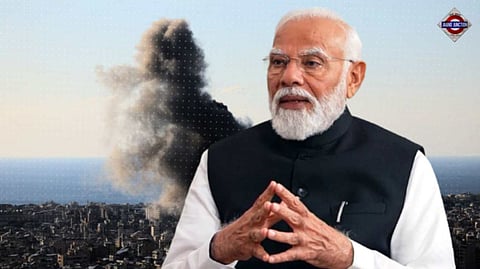

Prime Minister Narendra Modi, on Saturday, spoke to Iranian President Masoud Pezeshkian and condemned the attacks on critical infrastructure across Iran, which he described as a threat to regional stability.
In a post on ‘X’, PM Modi wrote, “Spoke with President Dr Masoud Pezeshkian and conveyed Eid and Nowruz greetings. We expressed hope that this festive season brings peace, stability and prosperity to West Asia."
Spoke with President Dr. Masoud Pezeshkian and conveyed Eid and Nowruz greetings. We expressed hope that this festive season brings peace, stability and prosperity to West Asia.Condemned attacks on critical infrastructure in the region, which threaten regional stability and…
The Prime Minister reiterated the significance of safeguarding freedom of navigation and called for ensuring the security of shipping lanes amid the blockade of Strait of Hormuz — a vital maritime chokepoint which accounts for one-fifth of the world’s oil and gas trade — which impacted energy supplies globally.
“Condemned attacks on critical infrastructure in the region, which threaten regional stability and disrupt global supply chains. Reiterated the importance of safeguarding freedom of navigation and ensuring that shipping lanes remain open and secure. Appreciated Iran’s continued support for the safety and security of Indian nationals in Iran", he added.
This was PM Modi’s second call with the Iranian President since the conflict in West Asia began with the February 28 U.S.-Israel coordinated strikes on Iran.
On March 12, PM Modi had spoken to Pezeshkian and conveyed his concerns over the regional conflict.
“Had a conversation with Iranian President, Dr. Masoud Pezeshkian, to discuss the serious situation in the region. Expressed deep concern over the escalation of tensions and the loss of civilian lives as well as damage to civilian infrastructure," PM Modi had said in a post on ‘X’.
The Prime Minister affirmed the safety and security of Indian nationals in the war-hit region remained India’s top priority, alongside the unhindered transit of goods and energy.
“The safety and security of Indian nationals, along with the need for unhindered transit of goods and energy, remain India’s top priorities. Reiterated India’s commitment to peace and stability and urged dialogue and diplomacy," he added.
India’s Stance On West Asia Conflict
India has been an advocate of “dialogue and diplomacy", calling for an early end to hostilities in West Asia.
Since the start of the war, Prime Minister Modi and External Affairs Minister S. Jaishankar have engaged with leaders from Iran, Israel, UAE, Saudi Arabia, Oman, and Qatar to emphasize that solutions must be achieved through negotiation.
While India condemned the Iranian strikes across the Gulf, it also ramped up diplomatic efforts with Tehran to secure the supply of gas and oil through the Strait of Hormuz — which came to a near-standstill following the retaliatory attacks by Iran across the Gulf.
