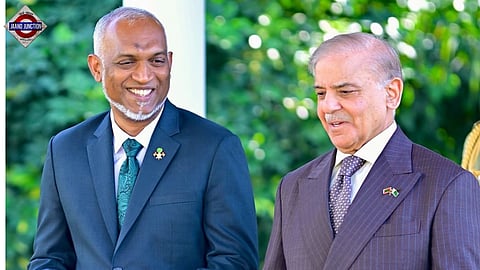

Maldives President Mohamed Muizzu, on a three-day historic visit to Pakistan, has met the who's who of the Islamic Republic. He met everyone from Prime Minister Shehbaz Sharif and Deputy PM Ishaq Dar to the powerful army chief, Field Marshal Asim Munir. Muizzu even donned a robe to receive an honorary doctorate from an Islamic university.
The three-day state visit, from October 20 to 22, saw the Maldives and Pakistan sign 20 agreements covering defence, maritime security, policing, trade and other sectors. Muizzu called for reviving the largely dormant South Asian Association for Regional Cooperation (Saarc), whose last summit was held in Kathmandu in 2014. His meeting with Pakistan's powerful army chief has added a strategic dimension to the diplomatic outreach. The developments have raised questions about whether the Indian Ocean island nation is moving closer to Islamabad, and what that means for New Delhi.
The international waters around the Maldives, located along vital Indian Ocean shipping routes, have traditionally been within New Delhi's immediate strategic neighbourhood and its sphere of influence. India maintained military personnel in the archipelago to operate and maintain aircraft used for humanitarian assistance and medical evacuations, but Muizzu's government secured their replacement with civilian technical personnel in May 2024.
The outreach to Pakistan comes against the backdrop of tensions with India, stoked by Muizzu himself, who rode the "India Out" campaign to power in 2023 but has since been working to repair the strained bilateral relationship.
At a joint press conference on Wednesday (October 22), Muizzu said, "The Maldives firmly believes in the value of Saarc, and in the tremendous potential of our region to address shared challenges through collective action." He also declared that Pakistan and the Maldives had agreed to "turn a new leaf, to build a new era of partnership on the foundations of our six decades of friendship".
Pakistan, meanwhile, used Muizzu's visit to raise its own disputes with India. According to an October 21 statement from Pakistan's Press Information Department, Sharif shared Islamabad's perspectives on Jammu and Kashmir and the Indus Waters Treaty (IWT), although Muizzu did not publicly endorse either position.

PAKISTAN-MALDIVES: 20 AGREEMENTS AND A NEW DEFENCE DIMENSION
Muizzu's visit was the first by a Maldivian president to Pakistan in 11 years and coincided with the 60th anniversary of diplomatic relations, established in July 1966.
Muizzu arrived in Islamabad on October 20 with First Lady Sajidha Mohamed and a high-level delegation. On October 21, Sharif welcomed him at the Prime Minister's House, where he inspected a guard of honour before restricted and delegation-level talks.
The two leaders witnessed the exchange of 20 memorandums of understanding and agreements covering defence, maritime security, law enforcement, civil aviation, health, education, agriculture, fisheries, tourism and technical training.
Both countries also agreed to raise bilateral trade from approximately $13 million to $200 million within two years. This is an ambitious target given their limited bilateral trade.
Muizzu described the agreements as an opportunity to establish a "new era" of cooperation. The Maldives President's Office confirmed that defence and security, training and capacity-building were among the priorities discussed.
MUIZZU MEETS MUNIR, PROPOSES SAARC REVIVAL
On October 21, Field Marshal Asim Munir, Pakistan's Chief of Army Staff and Chief of Defence Forces, called on Muizzu in Islamabad. According to Pakistan's state broadcaster, Radio Pakistan, the two discussed regional security, defence cooperation, institutional linkages and professional military exchanges.
Muizzu commended the professionalism of Pakistan's armed forces and appreciated Islamabad's stated efforts towards regional peace and stability. Earlier that day, Deputy PM and Foreign Minister Ishaq Dar had also met Muizzu to discuss trade, investment, education and tourism.
Muizzu's Saarc revival proposal was another significant diplomatic development. The regional grouping has remained largely inactive since the 2016 Islamabad summit was cancelled following the Uri terrorist attack by Pakistani terrorists and the deterioration of relations between New Delhi and Islamabad.
"India remains steadfast in its commitment to regional cooperation, connectivity and contacts but believes that these can only go forward in an atmosphere free of terror," MEA said in its statement after the Uri terror attack.
"In the prevailing circumstances, the government of India is unable to participate in the proposed Summit in Islamabad," the statement added.
On October 21, Muizzu said the Maldives was "firmly committed to playing a constructive and proactive role in revitalising Saarc". He added that Male was ready to work with member countries towards "convening the next Saarc Summit at the earliest possible opportunity".
Muizzu, however, is not the first South Asian leader to call for the organisation's revival in recent years. Back in 2025, Bangladesh's interim government chief, Muhammad Yunus, had also pushed for Saarc's revival during a meeting with Pakistan's Deputy PM Ishaq Dar, who was paying a visit to the country.
Saarc, an eight-member alliance, was established in Dhaka in 1985 and is headquartered in Kathmandu. India, Pakistan, Bangladesh, Sri Lanka, Nepal, Bhutan, Maldives and Afghanistan are the members of the cooperation. It's major aim was to promote regional economic growth, social progress, cultural development and collective self-reliance.
KASHMIR AND INDUS WATERS ENTER THE TALKS: POV PAK
Pakistan also brought its disputes with India into the discussions. Sharif's office confirmed that he shared Pakistan's perspectives on Jammu and Kashmir and the Indus Waters Treaty during his meeting with Muizzu. India put the Indus Waters Treaty in abeyance in April 2025, a day after the Pahalgam terror attack killed 26 people, citing Pakistan's continued support for cross-border terrorism.
At their Wednesday joint press appearance, Sharif warned that interference with Pakistan's water supplies would be regarded as an act of war. Importantly, Muizzu made no public statement supporting Pakistan's position on either Kashmir or the treaty.
Amid the meetings and agreements, Muizzu received an honorary doctorate in Politics and International Relations from the International Islamic University Islamabad on Wednesday. Sharif presented the degree at a ceremony held at the Prime Minister's House, with university rector Professor Ahmed Saad Al Ahmed in attendance.
According to the Maldivian President's Office, Muizzu dedicated the honour to the people of the Maldives, describing it as recognition of the friendship between the two countries.
IS MALDIVES MOVING INTO PAKISTAN'S ORBIT?
Muizzu's visit represents a notable expansion of Pakistan's engagement with an island nation of considerable strategic importance to India. China, too, has been seeking a stronger foothold in the Maldives, investing in major infrastructure projects under its Belt and Road Initiative (BRI). Beijing has financed and built bridges, housing projects and other infrastructure in the strategically located island nation, which have raised concerns in New Delhi over its growing influence in the Indian Ocean.
However, at least for now, the agreements do not establish a Pakistani military presence in the Maldives, and their operational implications remain unclear.
Muizzu's government continues to describe its foreign policy as "Maldives First", along with an emphasis of cooperation with multiple partners rather than exclusive alignment. For India, the immediate concern would be that Islamabad is gaining another opening in New Delhi's strategic maritime neighbourhood
Whether the defence and maritime agreements translate into sustained military cooperation will determine the real strategic significance of Muizzu's Pakistan visit.
