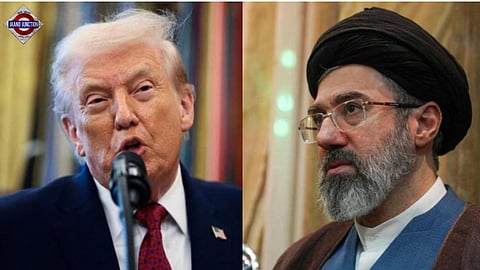

The latest round of indirect United States-Iran talks in Doha centred on the implementation of a memorandum of understanding, with discussions covering a proposed $3 billion release of frozen Iranian funds and an agreement to establish a communication channel to report violations of the deal.
According to Iran’s official IRNA news agency, Iranian Deputy Foreign Minister Kazem Gharibabadi announced the conclusion of the latest round of talks on implementing the MoU between Tehran and Washington.
Gharibabadi said the countries agreed that “a communication channel would be established by tomorrow" to report and record violations of the memorandum.
Speaking after Wednesday’s meetings, Gharibabadi said there were no direct discussions between the US and Iranian delegations.
According to Axios, he said all negotiations took place through Qatari and Pakistani mediators. He also said the parties agreed to establish “an emergency communication channel by tomorrow" to address violations of the MoU.
Gharibabadi added that the expenditure of Iran’s frozen funds in Qatar was discussed and that “it was agreed that, based on Iran’s stated needs, the required goods would be purchased and delivered to Iran."
According to Al Arabiya, an initial agreement has been reached to release $3 billion to Iran during the indirect talks in Doha.
The report said Iran linked the release of the funds to progress in the negotiations, with the amount to be released in phases as discussions advance.
However, a US official later told Al Arabiya English that no frozen Iranian funds have been released and that any future release would depend on Tehran meeting the conditions set out in the memorandum of understanding (MoU).
“No frozen funds have been released and no frozen funds will be released unless Iran meets the requirements outlined in the MOU," the official said.
The official added that, under the memorandum, “the United States must approve how the funds are used." According to the official, if Iranian assets are released, “they will be used to purchase American agricultural products from American farmers to feed the Iranian people."
According to Al Arabiya, a trilateral meeting involving Iran, Qatar and Pakistan was held to review the implementation of the memorandum of understanding.
The report said the talks covered the situation in Lebanon and the Strait of Hormuz.
According to the report, Iran accused Israel of undermining the implementation of the MoU by keeping its forces in Lebanon. In the meeting, Iran also maintained that the Strait of Hormuz falls under Iranian and Omani sovereignty.
Al Arabiya further reported that Iran requested the implementation of five provisions of the memorandum before moving on to other issues.
The report added that discussions are continuing on the Strait of Hormuz based on a new proposal presented by Oman, and that the negotiating delegations will return to their respective countries for consultations on the proposal.
Meanwhile, Qatar said the discussions made “positive progress" on issues related to the Islamabad Memorandum of Understanding.
In a post on X, Qatar’s foreign ministry spokesperson Majed Al Ansari said, “Qatar & Pakistan mediators concluded separate meetings with the US & Iranian negotiators in Doha today, with positive progress made on issues related to the Islamabad Memorandum of Understanding, building on the outcomes of the Lake Lucerne Summit."
He added that the two sides had agreed to continue the negotiations.
“The parties agreed to continue discussions over the coming period, with the next meeting to be scheduled at the earliest possible time following the funeral processions of the former Iranian Supreme Leader," Al Ansari said.
The indirect negotiations, mediated by Qatar and Pakistan, began on Tuesday night and continued on Wednesday.
The talks were structured through separate sessions involving chief negotiators and technical experts.
US envoy Steve Witkoff and President Donald Trump’s adviser and son-in-law Jared Kushner met Qatar’s prime minister ahead of the negotiations to help lay the groundwork for the talks.
The indirect talks in Doha are centred on the Strait of Hormuz, with the Trump administration arguing that a nuclear agreement would offer Iran greater economic benefits than revenue generated through tolls in the strategic waterway.
The two sides had set a 60-day timeline to negotiate a comprehensive nuclear deal after signing a memorandum of understanding. The current round of talks has focused on the implementation of that memorandum.
On Sunday, following several exchanges of fire, the United States and Iran reached an understanding to de-escalate tensions in the Strait of Hormuz for one week.

