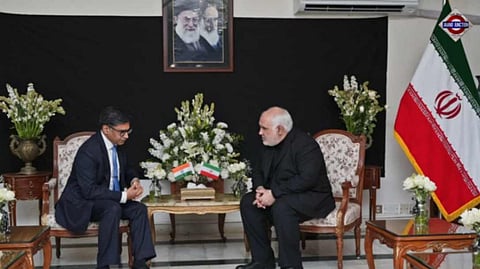

Foreign secretary Vikram Misri on Thursday signed the book condoling Supreme Leader Ayatollah Ali Khamenei’s killing, which has been laid out in the Iranian embassy in New Delhi, on behalf of the central government.
Misri offered his condolences towards Khamenei’s death in joint Israel-US strikes on February 28, as the two countries launched ‘Operation Epic Fury’ against Iran.
Misri met Iranian deputy foreign minister Saeed Khatibzadeh, who also visited the embassy to sign the condolence book. On the same day, External Affairs Minister S Jaishankar said he had a telephonic conversation with his Iranian counterpart Abbas Araghchi in the afternoon.
Though India has called for resolution of the West Asia crisis through dialogue and diplomacy, it has also chosen not to react to Khamenei’s killing. The foreign secretary’s visit can, hence, be seen as India’s first official recognition of the Supreme Leader’s death.
This also assumes significance as several opposition parties had criticised the Centre for not reacting to the strikes against Khamenei. India, meanwhile, has recently moved to formalise a diplomatic response focused on regional stability and the safety of its citizens.
Even as Misri’s act of signing the book can be seen as an official acknowledgement of Khamenei’s killing, India has shown diplomatic restraint in condemning the strikes that led to his death.The prime minister’s office has prioritised a “neutral" stance to balance ties with Israel, the US, and the Gulf states. But, the ministry of external affairs (MEA) has issued several statements outlining India’s primary concerns.
India has repeatedly urged all sides to exercise “restraint" and return to “dialogue and diplomacy". The government has said the “sovereignty and territorial integrity of all states must be respected".
A major driver of India’s policy is the safety of nearly 10 million Indian citizens living and working in the Gulf region. The MEA said India cannot remain “impervious" to developments that threaten the lives of its nationals.
India has said it is closely monitoring the conflict’s impact on energy supply chains and the India-Middle East-Europe Economic Corridor (IMEEC). The government has expressed “grave anxiety" over the disruption of merchant shipping in the region. It has issued a “no-travel" advisory for Iran and urged citizens currently in the country to leave via commercial flights while they remain operational.
Iranian state media, meanwhile, reported that preparations are underway at Tehran’s Grand Mosalla for the placement of Khamenei’s body. This massive prayer complex, used for the city’s most significant state-religious gatherings, is serving as the centrepiece for a three-day farewell ceremony. Following established protocol, the farewell ceremony will be followed by a funeral procession with thousands of mourners expected to gather to pay their final respects.
