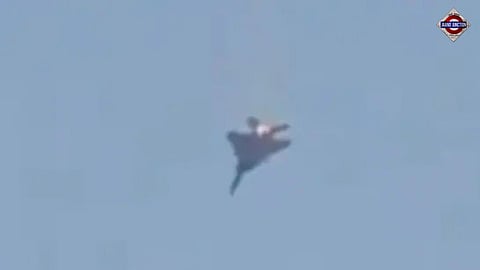

Hours after reports surfaced of Iranian air defences hitting a US F-15E Strike Eagle leading to its crash, the US Central Command rejected it saying they were “baseless".
In a post on X, the US Central Command said, “Rumors circulating on social media of a U.S. F-15E crash in Iran early Wednesday are baseless and NOT TRUE."
Earlier in the day, OSINTdefender had shared on X that a US F-15E Strike Eagle had reportedly crashed during a mission over southwestern Iran early Wednesday. It quoted a source attributing the crash to Iranian air defences.
According to the post, the US and Israeli combat search and rescue teams had launched entered Iran about an later and extracted the pilot and weapons systems officer.
The OSINTdefender later shared another post saying the previous post has been taken down.
“We have made the decision to delete reports made last night regarding the crash of a USAF F-15E Strike Eagle in Iran and the successful evacuation of the crewmembers by U.S. and Israeli Combat Search and Rescue (CSAR). Defender Media maintains confidence in its sources, however, the story is as of now being officially and publicly denied by U.S. Central Command (CENTCOM)," it said.
Previously, three American F-15E Strike Eagle(s) were shot down over Iraqi airspace near Kuwait, by Kuwaiti Air Defence systems.
The F-15 Eagle is a twin-engine, all-weather tactical fighter jet originally developed by McDonnell Douglas, which later merged with Boeing. The U.S. Air Force first flew it in 1972, and it entered active service in 1976. It was built with one core goal in mind: air superiority. That means its primary job is to control the sky, keeping enemy aircraft from operating freely in a given area.
The exchange of strikes between Iran and US-Israel entered its sixth day. The US and Israel launched strikes on Iran on February 28, as negotiations over Tehran’s nuclear programme faltered with the Middle East plunging into a renewed military conflict.
On Wednesday, an American submarine sank an Iranian warship. With the attack, Tehran threatened the destruction of military and economic infrastructure across the region.
The intensity of the attacks prompted the state television to announce the postponement of the mourning ceremony for Iran’s slain Supreme Leader, Ayatollah Ali Khamenei. Khamenei, 86, was killed in the coordinated US-Israeli strikes on Sunday.
