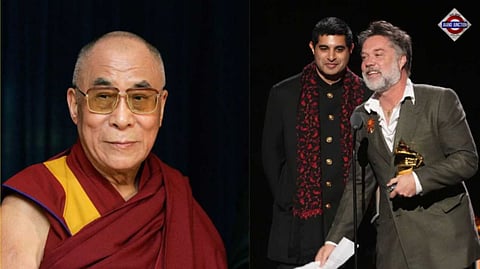

China on Monday criticised the decision to confer a Grammy Award on the Dalai Lama, saying it “firmly opposes” the recognition being used to support what Beijing describes as “anti-China activities”. The Tibetan spiritual leader, Tenzin Gyatso, won his first Grammy at the 68th annual Grammy Awards in Los Angeles, taking the prize in the Best Audio Book, Narration and Storytelling Recording category for his spoken-word album "Meditations: The Reflections of His Holiness the Dalai Lama".
The award was given at the ceremony on Sunday, marking a significant milestone for the 90-year-old leader whose reflections on peace and compassion have reached global audiences through the album.
The album blends the Dalai Lama’s teachings on mindfulness, harmony and human values with musical elements and contributions from several artists. "Meditations" was nominated alongside entries from figures including Trevor Noah and US Supreme Court Justice Ketanji Brown Jackson, an unusual crossover of spiritual discourse into a major entertainment award.
Responding to Beijing’s criticism at a media briefing, Chinese foreign ministry spokesperson Lin Jian reiterated the government’s long-standing stance that the Dalai Lama is engaged in political, not purely religious, activity. “The Dalai Lama is not purely a religious person,” Lin said. “He is a political exile committed to anti-Chinese separatist activity under the disguise of religion.” He added that China “firmly opposes relevant sides using the award as a tool to carry out anti-China activities”.
The Dalai Lama, a Nobel Peace Prize laureate and the exiled spiritual leader of Tibetan Buddhism, fled Tibet in 1959 after a failed uprising against Chinese rule and has since lived in India. His Grammy win came amid global recognition of his decades-long advocacy for peace, compassion and cultural dialogue, although the award also highlights persistent geopolitical tensions around Tibet’s status and the role of its spiritual leadership.
